Tuesday, July 15, 2008

Dialing Up the Yankees' Dellin Betances: Projections and Comparisons

If you grew up in Brooklyn, your favorite team growing up was the Yankees, and you had the stuff to be a Major League pitcher, where would you want to spend your career?

With the Yankees, of course. And that's how the story of Dellin Betances begins. He may or may not spend his career in the confines of the New Yankee Stadium, but he'll pitch there at some point, and he'll be pretty good at it. But even as I type up this post, I can hear Yankees fans saying, "Yeah, but how good?" And I can't blame them for wanting to know.

Betances has the pure talent to be a stud. Before I get into all the details, I want to suggest a few comparable pitchers, and then discuss what kind of stuff Betances brings to the mound.

Betances compares really well to Kerry Wood, followed by Billingsly, and then Harden. By the age of 22, each one of them posted an ERA at or below 3.40, so that's a great set of pitchers to be grouped with, and I think Betances has just as much potential as any of them. None of them was particularly good at keeping the ball on the ground, but they don't give up a lot of home runs, indicating that even when they leave a ball high in the zone, hitters don't usually catch up with it. In a perfect world I would like to see Betances post a GB% closer to 50%, but I'll take his current rate since he is relying so heavily right now on his fast ball to avoid contact.

Speaking of contact, I want to outline Betances pitching repetoire for just a moment. While most scouting reports say that his fastball sits in the low to mid 90's, I've read from several sources that he can reach 97 or 98 mph. Betances also has a change up and a curve that he has been working on since being signed by the Yankees, but it looks like both pitches are still very much works-in-progress. His future development of a good secondary pitch will probably dictate his ability to maintain his K/9 rate while keeping his GB% at acceptable levels. The pace that he is able to locate a curve or change up for strikes will probably determine how quickly he establishes himself in the majors, although I think his fastball is good enough to at least get him there in a couple of years.

While I don't like to deem a pitcher's body as "projectable", Betances has plenty of size, standing 6'7" and weighing in at somewhere around 230 pounds. His ability to repeat sound mechanics will likely determine his durability, but it doesn't hurt to be a 20 year old in a giant's body if you want to be a professional athlete, so he gets a plus for simply being a huge guy.

Anyways, now that we've covered the basics, let's talk about projections. If we follow the path of progression followed by Harden, Wood, and Billingsly, Betances could find his way to AAA by the end of 2009 with perhaps a chance of a call-up late in the season, and a shot at a starting spot in 2010. By then the Yankees should have a rotation that includes a much improved Phil Hughes, Joba Chamberlain, Chien-Ming Wang, and Ian Kennedy. That would give the Yanks a very solid front 3, with nice depth at the #4 and #5 spot.

If Betances stays on track, he should be fully capable of posting an ERA under 4.00 in the majors by 2010, and possible below 3.50. That would make him at least a 12-14 game winner, with a chance at 15 or more. It's hard to say how he'll do long term since both Wood and Harden have been injury prone, but he definitely has a chance at being a #1 starter, and possibly a Cy Young caliber pitcher. I don't want to over extend my projection, but I like what I've seen from Betances so far, and I think the best is yet to come.

...Read more

Medical Fact of the Day

Have you ever spent hours trying to go to sleep? How about days? Months?...
Fatal Familial Insomnia (FFI) is a rare genetically inherited disease that afflicts just 28 families worldwide, but is passed on to 50% of all offspring. FFI was first discovered in 1974 when an Italian physician learned of 2 women in the same family who had apparently died of insomnia. In 1984, another member of the family began to show similar symptoms. Doctors documented his fatal decline and flew his brain to the U.S. for further studies after his death.

Research has shown that a certain genetic mutation causes a build up of a plaque like substance in the hypothalamus, the part of the brain that regulates sleep. Between the ages of 30 and 60 years old, patients begin to exhibit insomnia-like sleep patterns, developing panic attacks and phobias over a period of 4 months. During the next 5 months, patients begin to hallucinate, followed by a 3 month period during which the patient is unable to sleep at all. At this point, the patient will suffer from extreme weight loss, and will soon suffer from complete dementia before going into a zombie-like state, exhibiting no response to the outside world. Ultimately, the patient dies due to a lack of sleep.

There is no present cure for FFI, and sleeping pills seem to only increase the rate at which the disease attacks the host. Gene therapy appears to be the only viable option, although it has been unsuccessful to date.

So, if you have problems going to sleep at night, just remember that it could be a lot worse.
...Read more

Monday, July 14, 2008

Jaime Garcia to Start Against Padres

Tony La Russa has announced that Jaime Garcia will start Sunday against the San Diego Padres, who are 12-22 against left handed pitchers.

The Cardinals have used Garcia as a reliever since his call-up, but feel that he is more valuable as a starter. While he has made some rough appearances at AAA in the past month, he turned 22 years old 6 days ago, and has shown that he has the talent to become an excellent starter. His best comparisons include Brandon Webb, Fausto Carmona, and Francisco Liriano, so it should be exciting to watch him against a team like the Padres. I'm going to go out on a limb and predict a stat line for the game...

6 IP, 3 H, 1 ER, 2 BB, 5 K

We'll check back Sunday evening or Monday morning and see how close my prediction was. Fell free to add your own.

...Read more

New Subscription Button Added

I still don't really know how RSS feeds work, but I figured I'd add a subscribe button and see what happens. If anyone knows how subscriptions know, help me out, would ya'?

Medical Fact of the Day Part II

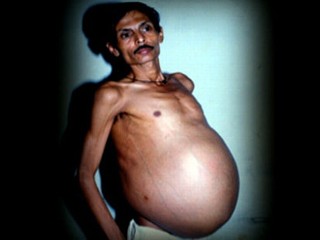
For those who would like to see what a fetus in fetu looks like...

Here's a photo of the man in India that had a partially developed fetus removed from his abdomen as well as the ABC News Fetus in Fetu Story.

This isn't the same fetus that was removed from the guy above, but it was the fetus involved in a similar case.Finally, an MRI showing a partially developed fetus inside a new born male. You can read the case report that was published in Radiology, a peer-reviewed medical journal.

Weird, but true.

...Read more

Medical Fact of the Day

We've all heard of triplets, quintuplets, sextuplets, and so on. But have you ever heard of a twin inside it's twin?

Fetus in fetu is a rarely occurring condition that results when a fetus surrounds and encapsulates it's twin during development in the uterus. Sometimes the encapsulated twin is absorbed, but on rare occassions it can continue to live and grow inside the larger fetus, sometimes for decades. A 36 year old man in India was rushed to a hospital after his abdomen became so swollen that he looked like he was 9 months pregnant. Doctors suspected a tumor, but were surprised to find a partially formed human inside the man's stomach, including hair, genitalia, arms, legs, and a variety of bones.

...Read more

Chris Davis vs. Hank Blalock (vs. Evan Longoria)

The Texas Rangers are having a difficult time with Chris Davis and his recent production. Not that he’s been horrible, but quite the opposite. Davis has been tearing through his first 64 plate appearances, with an OPS of .983, including 6 home runs, a triple, and 3 doubles. He also has 13 RBI in 17 games, and over the last 7 days he has posted an OPS of 1.014, with 3 home runs, a triple, and a double.

Any team would be happy to have Davis in their line-up, especially when you consider that his 22nd birthday was just this past March, and he’s on-pace for 29 home runs in just over 300 plate appearances (in case you’re interested, he’s on pace for 58 home runs given a full 600 plate appearances, and about 67-68 home runs over 700 plate appearances. Not exactly sustainable rates, but impressive nonetheless). So why are the Rangers so conflicted? Well, it’s mostly because Hank Blalock is expected back from the DL just after the All-Star Break, and it’s hard to tell a 27 year old veteran who has been with the club for years that his spot has been taken by a hot hitting 22 year old rookie.

If you were in charge of the Rangers, what would you do? The overall consensus is that Davis will either take a seat on the bench while Blalock starts, or Davis will be sent back down to AAA until his services are needed later in the year, or even in 2009. He’s been solid at the plate as well as defensively, but can you really hand over the keys to a young guy like Davis when you’ve got a veteran like Blalock coming back? I’d like to argue that you can.

If we compare Davis and Blalock side by side, there aren’t really many good reasons to choose Blalock. Obviously he has more experience, but what kind of experience? He’s never played for a winning ball club, and over the last 18 months he has just 330 plate appearances. His health has become a major concern, and his career OPS is below .800, so even if he was healthy there’s no guarantee he would be very productive. In terms of pure stats, the argument against Blalock is even more convincing.
Obviously, we have a small sample size for both players from 2008, so we should probably try and come up with a reasonable projection for Davis and compare it to Blalock’s stats from last year when he was healthy. Let’s say that Davis is capable of a .260-.270 average, and an OBP of about .340 (his AAA average this year was .333 with an OBP of .402), and his slugging percentage drops back down to non-superhuman levels of about .540 (he has averaged a slugging percentage of higher than .650 since his time in AA in 2007, so .540 is a conservative estimate). That puts him in line for an OPS of about .880, with somewhere between 20 and 30 home runs in 330 plate appearances. If Davis actually does hit close to another 20 to 25 home runs between now and then end of the season, his slugging would be much higher than .540, and he would likely post an OPS of .950 or more. To put these projected numbers in perspective, here’s one more chart comparing them with Blalock’s numbers from the 2007 season, when he posted his career bests in average, OBP, and OPS.
I threw Evan Longoria in there just to illustrate the fact that Davis is in elite company right now. Longoria is the leading A.L. Rookie of the Year candidate (and also 5 months older than Davis), but given the opportunity, Davis could end up posting numbers equivalent to or better than Longoria in his first 330 plate appearances. If a guy like Hank Blalock were on the verge of rejoining the Rays, there’s absolutely no way they would bench Longoria or send him back to the minors, and there really is no reason to do that with Chris Davis.

So is there really any question as to what the Rangers should do? I don’t think there is, and I think the choice is obvious. Even if Blalock comes back and produces at his absolute best without any further injuries, he would still barely be able to compete with Davis. Meanwhile, Davis would be grinding it out in AAA where he has nothing left to prove, or he’d be losing valuable opportunities for improvement while sitting on the bench. The Rangers should either trade Blalock or juggle the defense to work everybody in, but if they are serious about winning (both now and in the future), they’ll keep Davis on the field.


...Read more

Sunday, July 13, 2008

Medical Fact of the Day

Do you have extra stretchy skin? How about joints that dislocate easily?
Ehlers-Danlos Syndrome (EDS) is a condition that effects about 1 in 5,000 people that results from a defect in collagen production, the molecule that helps give skin and other body structures their strength and ability to adhere to other parts of the body. Collagen is one of the most abundant compounds in our bodies, making up 25% of our total protein content, and without it our body literally cannot hold itself together. Patients who suffer from EDS may experience a wide range of symptoms, and each patient may suffer a different level of symptom severity.

At it's most extreme, EDS can result in faulty blood vessel development and premature death due to severe internal bleeding (usually a rare development). There are no known cures for EDS, however patients are generally advised to avoid activities that may put excess pressure on joints, skin, and other connective tissues.
...Read more

Greg Halman Analysis and Comparisons

I’ve been seeing a lot of internet chatter recently regarding Greg Halman, who has been putting up some impressive power numbers in the minors over the past couple of years. While Halman does posses the capacity to put up some very big home run totals at a young age, I want to express a word of warning to anyone who is sold on this young man and his future as a professional baseball player.

My argument against Halman is not so much based upon his ability or inability to make solid contact with a pitch, but more so based on his approach at the plate and inability to make good decisions during an at-bat. Right now, Halman’s closest comparable player is Billy Ashley, a big time slugger in the Los Angeles Dodger’s farm system about 15 years ago who put up some very impressive minor league home run totals, but then struggled to accomplish much in the majors. A quick look at their stats can tell us a lot about just how comparable these 2 players are.
I generally don’t like to use batting average as a projection factor, but in Billy Ashley’s case, his inability to post a decent average eventually cut into his playing time at the major league level, and he ultimately only had 681 plate appearances in the majors, retiring his late 20’s with a career OPS of .716.

At its source, Ashley’s struggles can be attributed to the exact problem facing Greg Halman. While they both have high BABIPs (Ashley was consistently up around .400 and Halman is in the same range), they both have a K% of 30% or higher, and a BB% well below 10%. Other sluggers like Jack Cust, who strike out nearly 30% of the time, are able to compensate for their high strike out rates by posting a BB% close to 20%, or maintain high isolated power (ISO) numbers. To examine this trend more carefully, the following chart provides a list of hitters that posted a minor league K% close to 30% and their accompanying BB%. Some of these hitters have long since retired from the game or are still playing at the major league level, while others are current minor league prospects. Take a look at the list, and then take a second to consider exactly how successful each player was as a major leaguer, or how likely they are to struggle once they reach the majors.
Just by looking at these 2 stats, it’s not very difficult to come up with a rough estimate of each player’s chances of succeeding at the major league level. Four of the first 5 hitters became productive major league players, while the last group of hitters includes Billy Ashley and Wily Mo Pena, and we all know how those guys have done in their professional careers.

Certainly given enough time and opportunity, these hitters will eventually be able to prove themselves and probably find a permanent place on a team for at least a few years. But if we look at just a few more factors, we can focus each player’s chances of major league success just a little bit more.

From this chart we can see that in order for a hitter with a high K% to succeed in the majors, they must be able to compensate for their K%-BB% difference by having a higher ISO and/or BABIP. Otherwise, their on-base percentage and slugging percentage take the brunt of the burden, and they become average or less than average run producers. Of the hitters seen in the chart above that spent significant time in the majors, Billy Ashley and Wily Mo Pena have the worst OPS numbers, averaging .100-.150 points lower than the guys at the top of the list. With Greg Halman sitting at the bottom of that list, I can't imagine that he'll do any better than Ashley, and I doubt he'll become much of a major league ball player.

If Halman some how finds his way into a regular starting role in the majors, he might be a .250 hitter with the potential for 30-40 home runs at his peak, but as I stated above, his OPS will probably sit in the .750 or worse range for years. Every day center fielders that post those types of numbers aren't in very high demand, even guys who play solid defense and can steal a few bases (Andruw Jones posted a .725 OPS last year, and even though the Dodgers signed him for $18 million a year, he's struggling to keep a spot in the lineup).

Obviously, I'm not very high on Halman, and I don't think he's got much potential. Too many strike outs, not enough walks, and not enough power to make up for it.


...Read more

Saturday, July 12, 2008

Medical Fact of the Day

Trimethylaminuria is a rare metabolic disorder commonly known as "Fish Odor Syndrome." Patients suffering from this condition are unable to breakdown trimethylamine (TMA), the compound responsible for giving fish their "fishy" smell. The body releases the unprocessed TMA via sweat glands, urine, saliva,and reproductive solutions, creating a powerful fish-like smell that is constantly present.

There are no cures for Trimethylaminuria, but patients can modify their diets to decrease their levels of TMA, and mitigate the concentration of unpleasant odors.


...Read more