Showing posts with label more. Show all posts

Monday, September 7, 2009

TPC in Retrospect: Tommy Hanson 2009 Projection


Back in January I put together a post projecting Tommy Hanson's stats for 2009. At the time, it was hard to say how much the Braves would use Hanson, but ZiPS had him pegged for a total of 19 innings, a 5.21 ERA, and a 1-1 record. My projection wasn't perfect, but I think it was a bit better than the ZiPS projection.

To come up with my projection, I didn't simply grab some figures out of a hat. I compiled a list of comparables for Hanson and averaged out their performances during their major league season at the age of 23. At first glance, the compilation technique might not seem extremely accurate, but I think if we look a bit beyond the surface, we'll see that it is actually a very viable and mostly accurate approach.

Here's my projected line for Hanson coming into 2009:
7.9 K/9
4.1 BB/9
1.42 WHIP
4.56 ERA
.500 Win Percentage

Actual 2009 stats to date:
7.49 K/9
3.51 BB/9
1.25 WHIP
3.07 ERA
9-3 record, or .750 Win Percentage

The K/9 projection was relatively spot on, and the BB/9 projection wasn't too far off, but it would seem that my WHIP, ERA, and win percentage projections were completely obliterated. However, I would like to throw out another stat that Hanson has posted this year that will help make sense of the chaos:

Tommy Hanson 2009 tRA: 4.37

For those of you not familiar with tRA, here's the explanation given by fangraphs.com:

tRA involves assigning run and out values to all events under a pitcher’s control and coming up with an expected number of runs allowed and outs generated in a defense and park neutral environment. tRA is on a R/9 scale and does not involve any regression of the rates.

In essence, tRA gives us an idea of what a pitcher's true ERA should be given their overall performance throughout the season minus good luck and timely fielding.

Apparently, Hanson has had quite a bit of luck this season, and for whatever reason, his ERA is substantially lower than his tRA. This also helps explain why his WHIP and winning percentages seem to be so much better than my projections. Somewhere among all of his starts, there were a certain number of events that kept men off base and runners from crossing the plate while Hanson was on the mound, and his surface level stats depict a pitcher that is much different from his true production.

With that in mind, I feel like my projection of a 4.56 ERA is not far from Hanson's tRA of 4.37, and I think if we repeated the 2009 season 100 times in a vacuum, my projection would be remarkably accurate. Unfortunately, we don't live in a vacuum, and each season is only played once, and half of my projection has taken a sharp beating. I guess Tommy Hanson's good luck is by default my bad luck in this situation.


...Read more

Sunday, September 6, 2009

TPC in Retrospect: 2009 Top 10 Hitters: #6-10


Prior to the 2009 season, I put together my list of the top 10 prospect hitters, and I think it's about time I reviewed the list to see how I did. I'll start with the last 5 hitters, and then cover the top 5 hitters later this week.

6. Chris Carter (Oakland) -- I couldn't remember how highly Carter was ranked before this season, so I checked Baseball America, and they had him as the 76th best prospect in baseball, behind players like Jose Tabata, Taylor Teagarden, and Wilson Ramos. I understand why some folks don't like Carter, but hopefully his numbers at AA this year have opened some eyes. At 22 years old, he improved his plate discipline by posting career bests in K% (20.1%) and BB% (13.9%), while also posting career highs in batting average, OBP, SLG, and OPS (.337/.436/.576/1.012). To put that in context, Carter's numbers this year are almost identical to the AA stats of 22 year old Pedro Alvarez, who signed with the Pirates last year for a guaranteed $6.355 million. Not too shabby.

7. Max Ramirez -- This pick looks like my worst pick among the whole list. At 24 years old, I really thought Ramirez would force the Rangers to settle their future catching situation by trading at least one of their top catching prospects. However, no one has really stepped up to nail down the position, especially Ramirez. He has posted career lows in just about every category, and has been a complete disappointment in '09. There have been some injury issues, and maybe Ramirez just had a really bad year, but his future is looking a lot less promising than it was just 12 months ago.

8. Jesus Montero -- If I were to put this list together today, I'd definitely put Montero ahead of both Ramirez and Carter. His numbers this year were absolutely stellar, and I think he has a chance to be just as good as Miguel Cabrera or at least Pablo Sandoval. I think he's easily a top 10 prospect at this point, and maybe a top 5. It's amazing that Baseball America had him as the 38th best prospect heading into 2009.

9. Josh Reddick/Freddie Freeman/Lars Anderson -- During the preseason, I couldn't decide which one of these guys I liked more. At this point, I'd definitely go with Reddick. Anderson was much more hyped a few months ago, but he's struggled a ton, and has only gotten worse as the season has progressed. Freeman hasn't done too bad, but his power has dropped, and he probably won't be a major league contributor for another 3 years. Meanwhile, Reddick (who was completely left off Baseball America's top 100 list) was able to improve his plate discipline at AA while maintaining his power production, and has even been given a few spot starts with the Red Sox this season, hitting 4 doubles and a home run in 35 plate appearances.

10. Colby Rasmus -- I think putting Rasmus in at #10 was a good pick (Baseball America had him as the 3rd best prospect in baseball in front of Jason Heyward and Brett Anderson). He is obviously very talented, but will take a while to develop.

Summary: Looking back, I'd probably leave Ramirez off this list, include just Reddick at #9, and probably put Andrew McCutchen somewhere in my top 10 (probably around #8). I'm glad I left Travis Snider off the list (ranked #6 by Baseball America), who continues to struggle with Toronto, and I'm also glad I passed on Mike Moustakas (Baseball America's number 13 prospect, and Cameron Maybin (#8 by Baseball America).

Overall, I'd give my #6-10 list here a 'B'. I whiffed on Ramirez, but my other 4 picks were pretty good, so I'll take 80%. Could have been better, but could have been much, much worse.
...Read more

Wednesday, August 26, 2009

TPC 2009 Top 10 Hitters in the Midwest League


Over the coming weeks and months heading into the off-season, I'm going to be combing through a ton of minor league stats and highlighting the top 10 hitters and pitchers from each league this year. Today, I'd like to start with the top 10 hitters from the Midwest League.

I didn't spend a lot of time putting this list together, but I did spend a few hours breaking down stats and trying to eliminate players that I thought didn't belong in the running. I think the list is pretty good, but if anyone has thoughts about players I might have left off, let me know.

1. Jaff Decker -- At 19 years old, Decker is a rare mix of patience and power. He's not quite an elite hitter, but could very well develop into a blend of Pat Burrell and Adam Dunn, hitting 30 or more home runs a year, with an on-base percentage that floats around in the high-.300 area. Unfortunately, he'll also play in San Diego, which means he might have to settle for a bunch of doubles during the first few years of his career.

2. Josh Vitters -- Vitters moved up to advanced A ball in July, but while he was in A ball with the Cubs, he tore the cover off the ball. With 15 home runs and 28 total extra base hits in 288 plate appearances, he was on pace to put up some huge numbers. My biggest concern with Vitters is that he has yet to post a walk rate above 4.7% in his professional career, and this year he's sitting right around 2%. I don't think hitters necessarily have to walk a ton to be successful, but this could become a really big problem for Vitters at higher levels.

3. James Darnell -- The Padres have 2 of the top 3 hitters on this list, with Decker taking the #1 spot, and Darnell coming in at #3. At 22 years old, Darnell will probably be rushed through the minors, which so far hasn't been a problem, as he's posted an OPS of .965 or higher up through advanced A ball this year. His career numbers match up with an odd group of players that include Andy Laroche, Conor Jackson, and Alex Gordon, so it's hard to say at this point what the Padres can expect from Darnell.

4. Brett Lawrie -- Lawrie recently made the jump to AA, but I think a bit more time at A ball might have been a good thing for him. He has decent plate discipline with moderate power, but he seemed to struggle at times, and didn't show much improvement as the year progressed. Lawrie has the tools to be a very good player, but putting them all together might take some time.

5. Josh Fellhauer -- A 7th round pick by the Reds in the 2009 draft, Fellhauer came into professional ball as a hitter with what might be considered an average set of skills. But I like the fact that he signed quickly, and jumped right into A ball hitting 6 home runs in his first 2 months, and posted a strikeout rate of just 13%. He's not a big guy, and the power numbers may never substantially increase, but his overall make-up leads me to believe that Fellhauer should at the minimum make an average everyday major league player down the road.

6. Brett Jackson -- With a small sample size and suspect plate discipline, I'm not ready to believe this 2009 1st round draft pick is the real deal, but I'll give him a chance. Good defensive skills, raw plate approach.

7. Kyler Burke -- Burke's stats prior to 2009 were very average to say the least, but something seems to have clicked this year, and he has developed a lot as a hitter. He might regress next year, but for now I'll give him the benefit of the doubt and keep an eye on him in 2010.

8. Andrew Cumberland -- I really like to see a young hitter that can post a strikeout rate of about 10% and match that with a walk rate between 8% and 12%. It seems to be a good indicator for major league success. With that in mind, I think 20 year old Andrew Cumberland might have the skills to be a major league shortstop in the coming years. His highest career strikeout rate is just 11%, and this year he posted a walk rate of 12% while hitting .302.

9. Alexia Amarista -- Amarista has essentially the same stats as Cumberland, but will probably end up in the outfield or at second base, making him a little less valuable on defense.

10. Allan Dykstra -- I was hoping to see Dykstra really turn it on this season, but other than working the count a lot, I'm not sure he has much to offer. I'm not giving up on him entirely, but he's slowly fading from my radar.


...Read more

Friday, August 21, 2009

TPC in Retrospect: 2009 Top 20 Pitching Prospects #6-10

Last week I reviewed my top 5 pitching prospects for 2009, so this week it's time for the other 5 guys I ranked in the top 10. While there are a few changes I would make given the chance, I think my top 10 actually came out pretty good.

6. Neftali Feliz -- Up until about 6 weeks ago I wasn't sure how this pick was going to work out. Last year Feliz rocked AA hitters, posting 47 strikeouts in 45 innings, while hitting 100 mph on his fastball at the ripe old age of 20 years old. But Feliz struggled in AAA this year, posting a relatively meager 18% K% in April and June. I'm not sure if the learning curve was a little steeper this year, or if Feliz focused more on his secondary stuff, but it took about 3 months and a move to the bullpen before he looked like the pitcher we saw in 2008. Of course, we all know how well Feliz has performed at the major league level for the Rangers, accumulating 17 strikeouts in 11.2 innings with 0 walks, and a WHIP of 0.34. It's obviously not a very large sample size, but still very impressive. I hope Frank Wren never again allows a guy like Feliz to slip out of the Braves farm system.

7. Rick Porcello -- My gut told me to rank Porcello a bit higher than I actually did before the season started, but it seemed like there was going to be plenty of opportunities to reevaluate the Tigers young ace since he hadn't yet thrown a single pitch above advanced A ball. Guess I was wrong. The Tigers gave Porcello a spot in their starting rotation, and he has done quite well given his age and experience level. Looking back, I think I should have given Porcello the #4 or #5 spot and dropped David Price to #7.

8. Jhoulys Chacin -- This doesn't seem like a very radical pick, but going into 2009 Baseball America had Chacin ranked as the 46th best prospect in baseball, right behind Tim Alderson. I'm not saying this was a great pick by me, but I think having Chacin in my top 10 was a smart move. He's not going to be a dominant pitcher any time soon, but I think he could be just as good Jair Jurrjens in a few years.

9. Jairo Heredia -- Heredia was my most radical top 10 pick. He still isn't on any other top 50 list as far as I know, and I don't think he's going to get much attention for at least another 6 to 12 months. Heredia spent the majority of 2009 on the DL for a mystery injury, but has put in 26 innings at A and advanced A ball since July, collecting 21 strikeouts and just 3 walks. In retrospect, I might drop Heredia to #11 or #12 and maybe replace him with someone like Jenrry Mejia, but Heredia still deserves a lot more attention than he's been getting.

10. Christian Friedrich -- Baseball America ranked Friedrich as the 95th best prospect in baseball going into 2009 right behind Brad Holt, Phillippe Aumont, and Andrew Brackman, so I think I can give myself a pat on the back for putting him in my top 10. In 103 innings between A and advanced A ball, Friedrich has 140 strikeouts with just 37 walks, and has allowed just 74 hits. He still has work to do, but I wouldn't be surprised to see him get a shot at the Rockies starting rotation early next year.

Overall, I'd give myself a B+ for my #6-10 picks. I probably should have included Tommy Hanson in my top 10, but I'm still not completely sold on him (I'll explain later).
...Read more

Monday, August 17, 2009

2009 A.L. Rookie of the Year Update -- Position Players Still in Contention


Now that we've covered the N.L. position players still vying for Rookie of the Year, let's spend some time on A.L. position players.

Going into the 2009 season, Matt Wieters headed almost every preseason list, and I really thought he had the best chance to win ROY. But things haven't quite worked out for Wieters, and guys like Elvis Andrus and Gordon Beckham are stealing the spotlight.
Let's check the stats for a second, and then I'll cover the A.L. pitchers in my next post.I've highlighted the best stats for each category, and it looks like there are only 3 real contestants here: Elvis Andrus, Nolan Reimold, and Gordon Beckham. However, after looking at the stats of some recent R.O.Y. winners, I'm not sure Andrus has much of a chance. Historically speaking, guys like Elvis Andrus and Dexter Fowler have to do a lot more than steal 30 bases in order to take home the Rookie of the Year Award. Here's a quick list of the 6 most recent position players to win the award while stealing 20 or more bases.


If history is any indicator, Andrus and Fowler don't stand much of a chance. Here's how they stack up against the above players.

Not very comparable, is it? Ultimately, Gordon Beckham is probably the only rookie position player that has a shot at hitting .300 while posting an OPS around .850, which doesn't guarantee him anything, but at least puts him in the vicinity of historical averages in 2 categories.

Overall, I'd call this a very week year for rookie position players in both leagues, which means the R.O.Y. could very easily go to at least one pitcher, if not two.
...Read more

Sunday, August 16, 2009

2009 N.L. Rookie of the Year Update -- Position Players in Contention

Yesterday I took a look at the pitchers still in contention for the N.L. Rookie of the Year Award, so today we're going to take a look at the position players still in contention. There are some familiar names topping the list, but there are also a handful of surprises making a run at R.O.Y.

Pulling some averages from my preseason N.L. R.O.Y. post, here's how the top 6 rookie position players stack up (notice that my list does not include Garret Jones, who has hit just 2 home runs since July 24th).


With about 50 games left, let's assume each player accumulates somewhere around 200 at-bats (I think Casey McGehee is the only player on the list that isn't receiving full playing time). The only players that could possibly reach 20 home runs are Colby Rasmus, Casey McGehee, and maybe Andrew McCutchen, but I don't think any of them will actually accomplish the feat. I also don't think anyone will reach the 75 RBI mark, and I would be surprised if anyone ends the season with a batting average above .300.

Ultimately, I think this will come down to a three way race between Dexter Fowler, Chris Coghlan, and Andrew McCutchen. Fowler has the edge due to his speed, but no one is an obvious frontrunner when compared to the 3 pitchers I discussed yesterday.

To sum up the N.L. race, I'd give Dexter Fowler the overall lead right now, with J.A. Happ coming in second, and Randy Wells pulling in at third. After that, there's a 4-way time between Tommy Hanson, Andrew McCutchen, Chris Coghlan, and Casey McGehee. It should be a very interesting race over the next month and a half, and there's a good chance the award will ultimately go to the player who has the hottest September.
...Read more

Saturday, August 15, 2009

2009 N.L. Rookie of the Year Update -- Pitchers in Contention


Prior to the start of the 2009 season, I made some speculations about who might be in the running for the N.L. Rookie of the Year Award. It's still a bit early to declare an obvious winner, but there are a few interesting candidates that were no where to be found on any preseason list.

For my original 2009 N.L. ROY list, I included guys like Cameron Maybin, Colby Rasmus, Kenshin Kawakami, Tommy Hanson, and Dexter Fowler. Here's the basic projection I wrote up in my preseason post:

"...if I had to narrow down the field (for position players), I'd include Maybin, Fowler, and (Gaby) Sanchez. Overall though, I think this year's position players provide a relatively weak field of candidates, which opens up the opportunity for a pitcher to win the award.

"...I really can't single out any one player that I feel is going to stand out this year, and it might come down to who gets more playing time and doesn't screw up a whole bunch. To narrow it down, Kenshin Kawakami has the best shot at R.O.Y. simply because he has a secure starting role with major league team."

Well, we're over two thirds through the season, and it looks like Kenshin Kawakami is pretty much out of the race. With a 5-9 record and a 4.13 ERA, Kawakami can't possibly keep up with teammate Tommy Hanson, who has a 7-2 record, and a 3.05 ERA. Besides Hanson, Randy Wells and J.A. Happ have both added their names to the debate, each posting WHIPs of 1.20 or less, and ERAs of 3.01 or better.

Since Hideo Nomo won Rookie of the Year in 1995 with 13 wins, the fewest number of wins by any ROY pitcher was 12, when Scott Williamson finished with a 12-7 record and also had 19 saves and posted an ERA of just 2.41 in 1999. The average WHIP and ERA since Nomo has been 1.21 and 3.09 respectively.

There aren't any great rookie closers to add to the list, so for now it looks like Wells, Happ, and Hanson will be the only rookie pitchers making their cases over the next 50 games. At this point, I'm not sure if any of them has a distinct advantage, as each of them pitches for teams involved in a playoff battle with the offensive support and defensive capacity to keep them in line for at least 3 or 4 more wins. At least one of these guys is going to win 5 or 6 more games, and it's very possible that all 3 of them will still be in contention for Rookie of the Year at the end of the season.

Later this week, I'll break down the position players still in the running for N.L. R.O.Y. and then make some predictions about who will win it in the end.

...Read more

Friday, August 14, 2009

TPC in Retrospect: 2009 Top 20 Pitching Prospects #1-5


Finally, I got past my national board exam, and don't have to spend my days and nights memorizing anatomical anomolies of the head and neck and random biochemical metabolic mechanisms. At last, I can get back to reading and writing about baseball, and hopefully there are still a handful of people out there interested in reading my posts.


At the beginning of the 2009 season, I put together my list of the top 20 pitching prospects in baseball, and though the season isn't over, I thought it would be interesting to go back and look at how accurate or inaccurate my list was. I'll just post the names of the first 5 pitchers that made my list, and maybe make a comment or two. Over the next few days I'll work my way down the list.

1. Brett Anderson -- Although he got shelled this week facing the White Sox, at 21 years old, Anderson has displayed the capacity to be a very good pitcher. Not counting his start against the White Sox, over his last 58 innings Anderson has allowed just 16 earned runs, with 56 strikeouts, 18 walks, and 41 hits. According to fangraphs.com, Anderson has hit 95 mph or better on the radar gun in 9 of his last 11 starts, and his evolution as a pitcher has been much faster than I ever expected. If I could travel back in time and recreate my top 20 list, I'd still have Anderson at the #1 spot.

2. Trevor Cahill -- Cahill began the year with some very good starts, but has since keep runs off the scoreboard. His walk rate hasn't been great, and his 1.50 WHIP doesn't exactly inspire confidence in the Oakland faithful, but like Anderson, he's just 21 years old, and is still many years away from reaching his full potential. Even Hall of Famer Greg Maddux posted a 1.64 WHIP as a 21 year old with the Cubs, so don't write off Cahill just yet.

3. Brett Cecil -- Looking back, I don't know if Cecil would still be at #3 on my list, but I'd still have him in my top 10. Maybe I'd switch him with Rick Porcello, who I ranked #7 going into the season. Cecil hasn't been terrible, but he allows a lot of base runners and will need to make a lot of adjustments over the coming years. However, if you take the time to look, Cecil's numbers at the age of 22 compare very well with guys like Justin Verlander, Matt Cain, and Zack Greinke. Keep an eye of Cecil.

4. Madison Bumgarner -- Bumgarner gets a lot of attention, so I don't feel like I need to talk about him too much. He hasn't blown away AA hitters, but at 19 his 1.04 WHIP and 1.98 ERA over 82 innings would still land him in the top 5.

5. David Price -- At the start of the season, every top 10 prospect list had Price in their top 3, and had him as the #1 pitching prospect in the nation. I wrote a ton of posts illustrating why Price was undeserving of such accolades, and I feel a bit vindicated now that Price has proven himself to be very human, and is currently the owner of a 5.13 ERA and 1.55 WHIP, both of which are higher than the corresponding stats put up by Anderson, Cahill, and Cecil. Price is still a very talented pitcher, but if I could do it all over, I might consider dropping him down to as low as #7 or #8, and put Rick Porcello and Neftali Feliz ahead of him.

So that's my take on my top 5. I'd give myself a solid 'B+' with this list, with the exclusion of Rick Porcello as my biggest blunder. But I kept David Price out of the #1 spot, which up to this point in baseball history makes my list a lot better than a bunch of the other top prospect lists I saw heading into 2009.


...Read more

Tuesday, April 14, 2009

TPC Quick Comps: Jordan Schafer


The Braves are off to a hot start this year, and rookie centerfielder Jordan Schafer has done an excellent job both defensively and offensively. There's also been some talk of moving Schafer to the top of the order to utilize his speed. It's not a bad idea, but what kind of production could the Braves expect from the 22 year old at the lead off spot, and would his speed make up for his inexperience? Let's check his comps and find out.

I found a nice group of comparables for Schafer, and the news is part good and part bad for Braves fans depending on their perspective.


The good news is that the majority of the above players have shown a great deal of talent, and at least 3 of them (Sosa, Hunter, and Gomez) have proven to be adequate to above average major league ball players. Also, of the 7 players, Schafer posted some of the highest power totals (although, he was suspended last year for PED substance abuse), and his plate discipline was pretty good as well.

And now, the bad news. Of the above players that have seen significant time at the major league level, none of them would have made a very good lead off hitter as a rookie. Here are their major league production totals.


If we stretch out the home runs and extra base hit totals to 600 plate appearances, Schafer could be good for 12 to 18 home runs this year, and 30 or more doubles and triples, with 20 plus stolen bases. Overall, those aren't bad numbers, but with an average on-base percentage of just .303, the Braves would be much better off leaving Yunel Escobar and Kelly Johnson at the top of their order for the remainder of the season (.373 and .355 career OBPs respectively). The batting average also projects as less than ideal.

So, maybe Schafer isn't quite ready for taking over the lead off spot for the Braves, but it looks like he has a promising career ahead of him. If Schafer keeps up with his comps, in his prime he could hit between .280 and .300 with 20 to 30 home runs and 20 to 30 stolen bases per year.
...Read more

Monday, April 13, 2009

The Braves Report


I was cruising around on ESPN.com today and saw that they have released their MLB power rankings for the week with none other than the Atlanta Braves sitting at the #1 spot. Anyone can look good for a week (especially when they play a series against the Nationals), so I thought I'd take a closer look at how the Braves have done so far, and maybe break down some stats.

First, the offense...
  • As of today, the Braves are 6th in the majors in plate appearances per home run (21.3). Of the 5 teams ahead of them, Colorado, Tampa Bay, Texas, and Chicago will probably be in the top 10 all season long, and I expect the Braves to fall back about 10 spots by June (they came in at #23 last year).
  • The Braves rank 3rd in the majors in extra base hits with 29. I'd love to see them continue to hit the ball and rack up all these home runs and doubles, but last year they came in at number 19 in the country, and that was with Teixeira batting clean-up.
  • As a team, the Braves have struck out 42 times and walked 21 times in 2009, which puts them at about 15th place in the majors.
  • Atlanta currently has the highest team OPS in the majors, and is the only team above .900. In 2008 the Braves posted a team OPS of .753, suggesting that the offense is currently overproducing and will probably experience a huge collapse in the near future.
  • For those interested in pitch counts, the Braves have just 2 hitters in the top 100 pitches per plate appearance category: Casey Kotchman (#48) and Jordan Schafer (#68).
  • Of the 2 teams Atlanta has played against, Philadelphia's pitchers rank 12th in the nation with a WHIP of 1.36, and Washington's pitchers come in dead last with a collective WHIP of 1.86. The national average is 1.40.
Translation: Atlanta's offense was really hot last week against some very poor pitching. They displayed mediocre plate discipline, and so far have been very inept at working the count. Expect a lot fewer doubles and home runs in the coming weeks, and a lot of opposing pitchers taking advantage of the Braves hack-and-run philosophy by getting early strikes in the dirt or outside the strike zone.

And now the pitching...

  • Atlanta's pitching staff ranks 14th in the nation with a collaborative ERA of 4.17. Last year they finished the year about 50 points higher with a mix of very ineffective pitchers, so as long as the starters stay healthy this year, a 4.20 ERA seems reasonable. That would put them inside the top 15.
  • The bullpen has blown 3 saves this year, which ties them with Milwaukee for the worst bullpen in the country.
  • Atlanta's pitching corp ranks 23rd in the nation in WHIP.
  • Braves starters have provided 3 quality starts this year, which is on pace with the major league average.
  • Philadelphia and Washington rank towards the middle to lower end of major league teams in most offensive categories.
Translation: The Braves pitching has done a decent job so far, all except for a couple of blown saves by the bullpen. The starters have pitched well and aren't giving up a lot of early runs, but they haven't blown away the competition either. Expect more of the same, unless injuries derail the system.

The #1 ranking by ESPN seems a bit aggressive and ill-conceived, but as long as the Braves keep winning, I'll be happy.
Overall, the Braves are looking good, and the rotation looks to be much more dependable than last year. However, the offensive production is likely to taper off, and once it does I think Atlanta will probably carry a winning percentage closer to .500 throughout the season. ...Read more

Wednesday, April 8, 2009

TPC Quick Comps: Lars Anderson and Josh Reddick


Lars Anderson and Josh Reddick both put up some very solid numbers last season, and could soon add some pop to an already talented and youthful Red Sox team. I dug around to find some comps for each hitter, and I think there is good reason for Red Sox fans to be very optimistic .

First, the comps for Anderson (based off of minor league totals).


As it stands, I like the Wright comparison most. Posada didn't have quite the same contact capacity as Anderson does, and Walker had better power numbers, so they don't match up quite as well.

Anderson showed some extra power in 2008 at advanced A ball, so I also broke down the comparison based strictly off of A+ stats.


Once again, I think the Wright comparison is probably our best here. I think that ultimately Anderson will hit for more power than Wright, but not nearly as much as Walker, and should be a solid .290 plus hitter early in his career. I'll be interested to see if his home run numbers start to climb this year, but even if they don't he still projects as a 25 to 30 plus home run hitter with an upside of 35 to 40.

Here are Reddicks comps (once again, based off of minor league totals).


Overall, I feel most comfortable with the Jermain Dye comp, but Reddick has enough power and plate discipline to match up with Morneau and maybe even Braun over the next year or two.

Just for the sake of it, here are each player's A ball numbers (I wanted to use their advanced A stats, but I felt the A ball stats were more accurate for this comparison).


The Sox made it very clear last year that they wanted Reddick to become a more selective hitter and draw more walks, but it seemed to only mess with his head towards the end of the year, and he didn't respond very well. I've read several articles this spring indicating that the Red Sox will probably lay off a bit this year and let Reddick do his thing while quietly iterating pitch selection, and I think that's probably the best approach to take. Looking at the stats and comps, guys like Reddick succeed the most when they're swinging the bat and making contact, so why not let them? If he had a really bad strikeout to walk ratio it might be a legitimate point of focus, but the numbers suggest he'll probably be just fine.

Anyways, Reddick also projects as a .280 or .290 plus hitter early in his career, with 25 or 30 home runs and 40 on the up side. On the surface it seems that Anderson and Reddick will have essentially the same production level, but they'll get there in completely different ways. Reddick will always be a contact based hitter, while Anderson will be a much more patient on-base type player. Either way, I think they both should have very productive careers.
...Read more

Tuesday, April 7, 2009

Fun With Numbers: Matt Wieters vs Bengie Molina


After comparing Bengie Molina to Pablo Sandoval, I wanted to see how some of Molina's AA stats matched up against Matt Wieters, the #1 prospect in baseball. I was really shocked by the comparison, and it really left me scratching my head. Is Matt Wieters really the next Bengie Molina?

Here are each catchers numbers from AA.

Weird, huh? Of course, the sample sizes are sub-optimal, especially for Molina. But then again, anything over 200 plate appearances is large enough that you can't just completely dismiss it.

As I noted in the Sandoval vs Molina post, Molina bounced around between levels quite a bit in the minors, so it's hard to get a good read on how much of his production was talent and how much was luck. At the age of 21 he posted an OPS of .735 at AA, then went on to post an OPS of .956 and 1.003 at AA ball as a 22 and 23 year old respectively. I used his stats as a 21 year old in the Sandoval comparison since Sandoval played at AA as a 21 year old, and because that was the age at AA that Molina had the largest sample size.

In both the Molina vs Sandoval match-up and the Molina vs Wieters match-up we aren't really considering the whole picture, but it's just enough information that it creates a few problems with various solutions.

I think the most obvious thing to note here is that Molina had a career year during his time at AA at the age of 22 and 23, and for whatever reason he wasn't able to recreate the same level of production later is his career. It's possible that Sandoval also just went through a career year in 2008, and might plummet back down to his previous production level (.788 OPS at A+ in 2007), and it's possible that Wieters experienced a career year in 2008 as well.

There's something unsettling about the whole situation. My gut tells me that Wieters and Sandoval are both very much the real deal, and that Molina is the outlier in this situation, so I'll take that route for now, but I'll definitely keep this match-up in mind.


...Read more

Monday, April 6, 2009

Pablo Sandoval vs Bengie Molina


After posting a few times about Pablo Sandoval, I was a bit curious to see how he matched up against current Giants catcher Bengie Molina.

Molina spent time at advanced A ball during 2 separate seasons, and played at AA ball during 3 separate seasons, so the first thing I had to do was to determine which years to include in the comparison. Ultimately, I went with the largest sample size closest to the age the Sandoval played at each level. It might not be a perfect approach, but I think it provides a moderate baseline of stats for each player.

Here's their advanced A ball stats.

To keep things short and simple, using these numbers it looks like Sandoval is about 2 years ahead of Molina in terms of power and contact capacity, and about a year behind him in plate discipline.

On to AA stats (Notice that the best numbers I could come up with for Molina at AA ball were before the numbers used for the advanced A comparison. Like I said, Molina went back and forth between levels, so I went with what I felt matched up best).

Once again, Sandoval looks to be much more advanced in the power and contact departments, while falling a bit behind in plate discipline.

So, what does this all mean for Sandoval? Well, Molina has hit in the .275 to .295 range most of his career, with between 15 and 20 home runs a year (he usually averages about 450 to 500 plate appearances a year, so if you stretch his home run total out to 600 to 650 plate appearances you get 20 to 25 home runs a year). Not bad numbers for a catcher, but pretty lousy numbers for a guy who hits in the middle of the order.

If Sandoval gets 600 plate appearances, I think he could hit 20 to 40 points higher than Molina, and hit anywhere from 5 to 15 more home runs per year. That puts him in the .295 to .315 range with 25 to 40 home runs on the high side. That's pretty much in line with my other projections for Sandoval. I'm thinking maybe David Wright without the stolen bases and about half the walks?
...Read more

Sunday, April 5, 2009

Sleeper Pitching Prospect Red Sox Style


The Boston Red Sox have done a great job over the past several years drafting and developing excellent young pitchers. Clay Buchholz, Justin Masterson, Jon Lester, and Michael Bowden have all come through the Red Sox farm system, and are all poised to help create perhaps one of the most talented and deepest young pitching staffs in the majors. While most teams would be ecstatic to have such talent in the wings, the Red Sox are quickly restocking their minor league pitching pool.

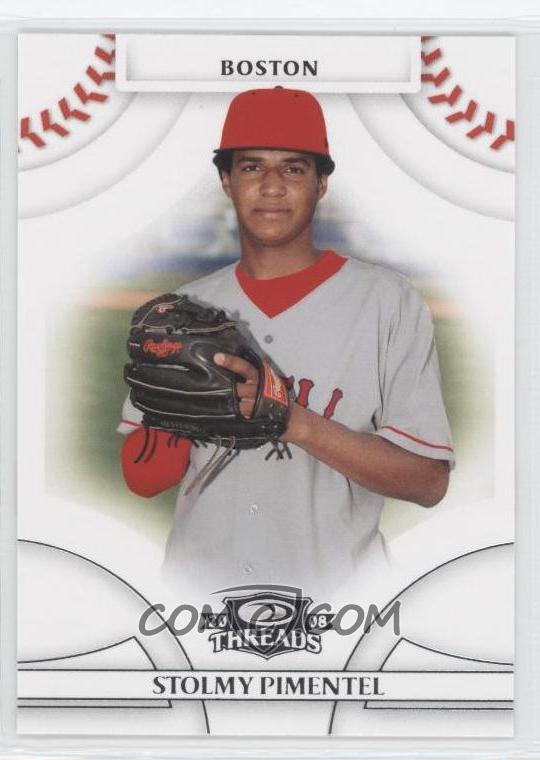
One of the up-and-coming young pitchers for the Sox is a young man by the name of Stolmy Pimentel, a 19 year old right hander from the Dominican Republic. Though young and inexperienced, Pimentel has 4 pitches, including a 94 mph fastball, a very good changeup, a curve, and a sinker in the making. At short season A ball in 2008, Pimentel averaged 8.7 strikeouts per 9 innings, while allowing just 2.4 walks and a WHIP of 1.08. With a career ground ball rate of 49%, the development of his sinker and curve should help him keep the ball on the ground more often, as well as create more headaches for hitters over the years.
...Read more

Friday, April 3, 2009

TPC Video Break: The Freak

A nice compilation of Tim Lincecum related clips for your viewing pleasure.


I really like the comparison between Lincecum and cricket bowler Shoaib Akhtar, who at one point held the world record for fastest cricket ball in the world (100.2 mph). Both Lincecum and Akhtar use "momentum pitching", which helps them attain maximum velocity by creating a significant amount of forward momentum with their bodies, which is then transferred to the ball via their arms.


In contrast to the momentum approach, here's a clip of Felix Hernandez, who actually comes to a complete stop in his motion before throwing to home plate.


I'm not an expert when it comes to pitching mechanics, but I would much rather see a pitcher use their whole body like Lincecum than to use the stop-and-start motion that Hernandez uses. It seems to me that by utilizing your body more, it reduces the overall stress on your arm, and increases velocity without increasing fatigue. There's a really good article at Drive Line Mechanics about Hernandez and the whole momentum versus stop-and-start pitching approach.

Daisuke Matsuzaka seems to have a mixed approach, creating some momentum, but not quite as much as Lincecum.


This final clip is of Greg Maddux during a bullpen session. He uses a very smooth momentum based approach that allows him to create velocity without putting much strain on his arm, and allows for a very efficient approach.


Everybody's different, so it's impossible to say that one approach is always better than another, but I think I prefer the momentum based mechanical approach.
...Read more

Pablo Sandoval Projections: The Remix

Yesterday I went over some numbers to try to illustrate why Pablo Sandoval is not the next Albert Pujols. I still don't think he's going to be as good as Pujols, but after digging through some stats and giving Sandoval's recent offensive breakout some consideration, I've decided that Sandoval might be a lot better than most people realize.

When I put up Pablo's numbers against Pujols, Miguel Cabrera, and Brian McCann yesterday, it looked like Sandoval might be on his way to a decent career as a Miggy Lite, or maybe a Venezuelan Brian McCann. Using his minor league totals, it certainly didn't look like Pablo was anywhere near as talented as Albert Pujols.

Using these numbers (which is what most projection systems go by), the relationship between Cabrera, McCann, and Pujols just didn't look right. After going over the stats, I noticed that prior to 20 years old, Cabrera and Pujols were both very mediocre hitters (Cabrera had very little power, and Pujols was a 13th round draft pick). Somehow, they both broke out at the age of 20 and went on to be incredible hitters. Since Sandoval seems to have taken the same offensive path, I think it would be much more accurate to use his stats as a 20 year old instead of his minor league totals (the same goes for Cabrera).

I'm not really sure why or how it happens, but some players don't put all their talent together until a couple to several years after high school. David Wright and Ryan Howard followed very similar routes, putting up mediocre totals until suddenly breaking out. It seems like Sandoval is following a similar route, so using his total minor league stats is probably the wrong way to go about analyzing him. Instead, I think a more accurate approach would be to use his numbers from his highest minor league level.

Going by these numbers, Sandoval will likely post a .300 average in the majors, with 25 to 30 home runs this year. Over the next 10 years, he's capable of hitting well over .300 with 30 to 40 home runs a year. It's a very basic approach, but I think it's more accurate than what most projection systems are predicting right now.

He still doesn't look like the second coming of Albert Pujols, but he'll do a very nice impression of Miguel Cabrera at times, and put up some very nice totals.
...Read more

Thursday, April 2, 2009

TPC Quick Comps and Projection: Pablo Sandoval


Pablo Sandoval is the type of hitter fans love to watch. He'll swing at just about anything, and actually makes contact often enough that it isn't too painful to watch. I think Sandoval could surprise a lot of people in San Francisco this year, but I also think expectations might exceed his true capacity. In an article for ESPN, Hall of Famer Willie McCovey was quoted as saying, "I think (Pablo Sandoval is) a natural born hitter. I went out on a limb last year and said I think he's going to be another Albert Pujols. I know it's high praise, but that's kind of who he reminded of when he first came up."

No offense to Mr. McCovey, but Sandoval definitely ain't no Albert Pujols.


Here's a quick list of comps for Sandoval, including Albert Pujols. All stats are minor league averages.


Those are decent comps, but in terms of plate discipline and power, Sandoval comes in dead last. That doesn't mean he won't be any good, it just means that he's probably going to only be half as good as Albert Pujols. If he's lucky, maybe he'll turn into a Miguel Cabrera or Brian McCann and hit close to .300 his first few years with 20 to 30 home runs, and then have a career year or two with 35 or 40 home runs before his power begins to taper off.

Most projection systems have Sandoval hitting between .290 and .310 this year, with 17 home runs. I don't completely disagree with those numbers, but I think they could be off, maybe even severely off. Just looking at Sandoval's stats from 2007 and 2008 and excluding his stats from A ball, he actually projects as a .310 to .320 hitter with 25 to 35 home runs this year. I'm not saying it's going to happen, but it's definitely a possibility. I think it's important to at least give a bit more weight to his most recent stats, so I think the following stat line is reasonable for Pablo in 2009.

.315 Batting Average, 25 Home Runs, .830 OP,
85 RBI, 14% K%, 4% BB%

Definitely not a bad projection, but certainly not as good as Albert Pujols (.359 batting average, 43 home runs, 1.106 OPS at the age of 23).


...Read more

Wednesday, April 1, 2009

TPC Prospect Smackdown: Michael Stanton vs Cody Johnson (vs Michael Stanton)


Young hitters with elite level power don't come around often, which explains the intrigue in guys like Michael Stanton and Cody Johnson. Both hitters can absolutely crush the ball, and both hitters have been known to accumulate a substantial amount of strikeouts. In 468 at-bats at A ball last year, Johnson hit 26 home runs and struck out a whopping 177 times. Stanton also had 468 at-bats at A ball in 2008, clearing the fences 39 times while striking out 153 times. So, the question begging to be asked is which slugger is better, and which one has the brightest future ahead of them?

To make things simple, let's just throw up each hitters stats from A ball last year.


Without too much analysis, I think it's obvious that Stanton is already quite a bit better than Johnson. Sure, they both hit the ball really hard, but Johnson's strikeout to walk ratio is really bad (1 being really good, 2 being average, 3 bad, and anything over 4 is really bad), and just by looking at the numbers it seems that he just swings the bat as hard as he can and hopes to make contact. Stanton, on the other hand at least displayed reasonable plate discipline, and put up much more substantial power numbers (his IsoP was the highest for any 18 year old at A ball that I can find on record). Toss in the age difference, and I think the comparison isn't even close.

If we end the smackdown right now, Stanton walks away with a sound victory. But if we dig a bit deeper, it gets even better. Here are each players monthly stats for 2008.


Johnson had a pretty good August, but other than that, his strikeout to walk ratio was generally very bad, and his power and average weren't all that impressive either. Stanton started the year looking a bit lost, but by June he had found his stride and really started to crush the ball. By July, his plate discipline had dramatically improved, and over his last 200 plate appearances he posted a strikeout to walk ratio of 1.56, and an IsoP of .365.

Normally, I don't like to consider a player's month-by-month performance line, as hot streaks and luck can significantly effect stats, but in Stanton's case, the improvement from April to August was so dramatic and followed such a smooth linear pattern, that I couldn't disregard the month to month changes. After a bit of research, I was very interested to find this excerpt from an article on mlb.com.

"Before the All-Star break, (Stanton) hit .281 with 15 home runs and 47 RBIs. An aggressive hitter, he struck out 86 times in 249 at-bats.

After the break, his numbers improved to .306 with 24 home runs and 50 RBIs in 219 at-bats. With a better command of the strike zone, his strikeouts reduced. He fanned just 67 times and drew 42 walks in the second half.

'He wants to be good on defense -- he just wants everything,' (Marlins' vice president of player development and scouting Jim) Fleming said. 'When we identify something for him, he works at it. One of the things we identified in the second half was, let's see if he can cut down on his strikeouts.'

He did."


I've heard of a lot of teams asking a lot of sluggers to work on their plate discipline, but I can't think of an instance where such dramatic improvement was achieved as quickly as what Micheal Stanton did in 2008. To give you an idea of just how drastic the change was (especially for an 18 year old), here are some A ball stats posted by various power hitters from the last decade or so matched up against the pre-All-Star Stanton and the post-All-Star Stanton, as well as Cody Johnson.


Depending on which Mike Stanton is the real Mike Stanton, we could be looking at either the next Russell Branyan/Wily Mo Pena, or the next Alex Rodriguez/Andruw Jones with substantially greater power.  But which one is it?  We'll probably learn a lot about Michael Stanton over the next 6 months, particularly how real his development at the plate was from July to August last year.  

If I had to make a guess, I would probably take the optimistic route with Stanton, and say that he's probably going to post a K/BB ratio of 2.5 or better in the coming year, maybe even under 2.0.  Unlike Alex Rodriguez and Ken Griffey Jr., Stanton was drafted as a very raw hitter.  In high school he played football, basketball, and baseball, and in his own words, he never had the chance to focus on just one sport.  

"It was always, I'd have basketball practice and baseball hitting at night.  Or during baseball season, I'd have to go to the gym and shoot, to keep up with all three sports.  I was pretty interested in seeing how it would be like to stick to one sport all the way through, and not have to deal with but one."

With three sports taking up his time in high school, it's easy to see why Stanton didn't get much attention heading into the 2007 draft.  Scouts saw very little of him, and pretty soon Pete Carroll at USC began recruiting Stanton as a wide receiver.  As Jim Fleming said in an article by Peter Gammons, "A lot of people didn't see a lot of him... He didn't do a lot of showcases."  If you know anything about high school football and the recruiting process, you know how time consuming it can be, and you know that anyone good enough for division I football probably doesn't have a lot of time to spend at baseball camps working on his swing mechanics.  

Whereas Cody Johnson spent three summers slowly posting slightly improved stats between rookie ball and A ball, Michael Stanton went from ground zero to the top in a matter of months.  Essentially, Stanton started minor league baseball as a novice.  He wasn't the son of a major league star, and he hadn't spent years refining his skills on the diamond, and to see a player like Stanton go from where he was in April to where he ended up in August speaks volumes about how good he could be.  In one summer he acheived more than a lot of hitters do over the course of  5 or 6 years.  Call it a learning curve, a developmental curve, or a whatever curve, but Michael Stanton's curve seems to climb higher and faster than just about any hitter I've come across.  Had he focused solely on baseball at the high school level, it's possible that he could have entered the '07 draft as polished and as talented as a young Alex Rodriguez.

Of course, I'm extrapolating some of these assumptions from vague comments and rudimentary data, but they all seem to point in the same direction.  Michael Stanton isn't your typical high strikeout minor league power hitter.  And while there's absolutely no reason in the world for anyone to believe my non-professional opinion, consider this final comment from Jim Presley, the Marlins hitting coach.

"I saw Ken Griffey Jr. play when he was 19, and (Stanton) is right there with him... Griffey was better defensively and had a better idea of how to hit .300.  (Stanton) has to learn the finer things, but he has skills.  He is a tremendously skilled player at 19.  He is going to be some kind of player.  This kid is an unbelieveable talent to be 19."


...Read more

Tuesday, March 31, 2009

TPC Quick Comps: Adrian Cardenas


Middle infielders sometimes don't get much respect simply because they rarely put up big offensive numbers. I'll admit that I often skim over second basemen stats without much thought. So, in an effort to break bad habits, it's time to give some attention to guys like Adrian Cardenas. I think a lot of people will be surprised by these comps. I sure was.

Adrian Cardenas Comparable Players:
(All stats reflect minor league totals)

Obviously, 2 of the players on that list are or were Hall of Fame caliber players, so it might seem like a bit of a stretch to compare Cardenas to them. However, the important thing here is that Jeter, Sandberg, and Phillips all hit between 20 and 30 home runs in their prime, while maintaining an average in the .280-.310 range, give or take a 10 points.

Of the 3 comps, I think Cardenas compares best to Sandberg, except that Cardenas hits from the left side of the plate which should add anywhere from 10 to 30 points to his batting average every year. Now that he's in the Oakland system, I also expect his K/BB ratio to drop a bit more. Depending on the source, Cardenas is listed as a second baseman or a shortstop, and I've even read a few times that he might end up at third base. I'm not sure what Oakland has in mind, but I'd like to see him make at at short, or moved back to second.


...Read more

TPC 2009 Top 10 Ground Ball Pitchers


Ground ball pitchers don't get a lot of street cred for their skills, but many of them have gone on to have very good (and even great) success at the major league level. Some of the most recent big name ground ball pitchers include Greg Maddux, Brandon Webb, Chien-Ming Wang, Derek Lowe, Fausto Carmona, and Justin Masterson just to name a few. The rising class of minor league ground ball pitchers looks to be just as impressive.

(Note: Players with no experience beyond A ball are ranked more conservatively than other pitchers unless they had over 200 total innings pitched. While ground ball rates tend to stay in a relatively small range throughout a pitcher's career, minor league rates at A ball can be overly inflated on occasion, especially in small sample sizes.)

1. Zach Britton -- Oriole Park at Camden Yards had the highest home run factor of any major league park in 2008 (1.359), so it's easy to see why a big time ground ball pitcher could be a welcome sight for the Orioles faithful. With a total of 245 innings under his belt, Britton has averaged a ground ball rate of 63.8% in the minors, with a high of 71% last year in April.

2. Jhoulys Chacin -- Like the Orioles, the Rockies need every ground ball they can get. In 2008, Coors field came in as the 3rd most home run friendly park in the nation, posting a home run factor of 1.299. Chacin has a career ground ball rate of 62.5%, helping him to post a 2.31 ERA last year in the hitter friendly California League.

3. Trevor Cahill -- The Athletics have done a great job teaching their young pitchers the importance of efficient pitch counts and keeping the ball on the ground, and Cahill is a ground ball champ. At just 21 years old, Cahill will most likely spend the majority of his season at the major league level, taking his 61.3% ground ball rate with him.

4. Rick Porcello -- Porcello actually has the highest career ground ball rate of all the pitchers on this list (65%), but with just one season under his belt, he conservatively projects as a 60% plus pitcher, thus the #4 ranking.

5. Brett Cecil -- With one of the best major league defenses behind him, Cecil is set to make a big impression when he takes his 60.2% ground ball rate with him to Toronto later this year.

6. Brett Anderson -- Anderson is just one more example of why Oakland is able to compete year in and year out. Like Cahill, Anderson will likely spend the year at the major league level at the ripe old age of 21, putting his 59.5% ground ball rate to work for the A's.

7. Evan Anundsen -- A bit of a sleeper prospect, Anundsen kept the ball on the ground 61% of the time last year at A ball, good enough for #7 on our list.

8. David Robertson -- After posting a minor league career ground ball rate of 58.2%, Robertson saw that number drop to just 44% last year with the Yankees. Look for him to rebound in 2009.

9. Jordan Walden -- The Angels should be very happy with Walden's progress up to this point, keeping the ball on the ground 57.7% of the time.

10. Clayton Mortensen -- Prior to posting a 48% ground ball rate at AAA last year
dropped his career average down to 57.3%, Mortensen had a career ground ball rate of over 60%.

Other ground ball gurus:

Nick Barnese - 55%
Bryan Augenstein - 57.3%
Jairo Heredia - 57%
Eammon Portice - 58.7%
Scott Diamond - 56.7%
David Price - 55.9%
Vin Mazzaro - 55.9%

...Read more