


Like I said, it doesn't have much to do with anything, but interesting nonetheless.
Thursday, January 22, 2009
Minor League Mayhem
This really doesn't have much to do with anything, but I was reading a short post about Chris Davis at John Sickel's Minor League Ball, and apparently Chris Davis has become quite a polarizing player. The post -- which simply asked where you would rank Davis in the top 50 if he were still considered a prospect -- is followed up by a huge and heated discussion about his strikeout rates, home run totals, minor league vs major league stats, etc. etc. It's amazing that less than 6 months ago Davis was getting next to zero publicity, and suddenly during the offseason he's become one of the most debated topics among stat heads.


Wednesday, January 21, 2009
TPC 2009 Projection: Justin Upton

Last year, Justin Upton started the season crushing the ball, before he cooled off and finished the year with a .250 average and a .816 OPS.
So, what can we expect from J-Up in 2009?
Here are the CHONE, Bill James, and Marcel projections for Upton:
CHONE: .257 average, 16 home runs, 60 RBI, .793 OPS
Bill James: .263 average, 22 home runs, 68 RBI, .844 OPS
Marcel: .264 average, 13 home runs, 45 RBI, .806 OPS
Everyone seems to be projecting basically the same numbers, except that the Bill James numbers are based off of 576 plate appearances, the CHONE numbers are based off of 492 plate appearances, and the Marcel system is going off an estimated 424 plate appearances, as compared to the 417 plate appearances Upton made in '08. While I think the projections are very reasonable, I think there are a few things to consider that might help us create a more accurate projection.
First, each of the above projections has Upton striking out somewhere between 27-29% of the time in 2009. While that's a bit of an improvement over his 29% in 2008, it severely downplays the capacity of a young player with Upton's talent to improve his contact rates early in his career. Here are just a few examples of the improvement young hitters can make in just a single season:
 Obviously, not every player sees such improvement so quickly (Justin Upton's brother, B.J. actually saw his K% increase by about 7% in his second year, before it dropped in his third full season). But Justin kept his K% below 26% in July and September with the Diamonbacks, and I think we're more likely to see him decrease his strikeout rate in '09 rather than an increase or no change at all.
Another point I'd like to make is that I doubt the Diamondbacks are going to spend much time moving Upton back and forth between the majors and the the minors this year. Instead of 417 plate appearances, we can extend Upton's '08 home run rate to 600 plate appearances, which gets us somewhere around 22 home runs. If Upton improves on that rate by just a fraction, I think 25 home runs is not an unreasonable expectation.
One last thing to point out is that Upton posted a .169 batting average during away games. Young players have to make a lot of adjustments when they reach the majors, and traveling to new ballparks can often overwhelm them. While they may have had a consistent travel routine in the minors, traveling in the majors requires adjustment to new cities and new schedules, and it can all amount to one major distraction. Given time, I expect Upton's away game stats to dramatically improve, and as a result his overall stats should get a nice boost.
So, with all that said and out of the way, I think Upton should be good for the following stats in 2009:
TPC 2009 Projection for Justin Upton: .268 batting average, 24 home runs, 75 RBI, .835 OPS
Overall, those stats are most similar to the Bill James projection, so we'll revisit this post in 10 or 12 months and see how it looks. I wouldn't be surprised if Upton hits closer to .275 or .280 with 25 to 30 home runs, but for now we'll stick with the above numbers.
Tuesday, January 20, 2009
TPC 2009 Projection: Tommy Hanson

The following projection is based off of the assumption that the Braves will call up Tommy Hanson sometime in 2009. I'm not going to try and guess exactly when they'll call him up, but barring injury or some kind of horrible start in AAA, he should be called up sometime before the All-Star break.
Before we come up with a rough projection, let's first identify some pitchers that have posted similar minor league numbers to Hanson (each pitcher was 21 during their time at AA; all stats are overall minor league averages).

Of these 5 comparable pitchers, I think Johnny Cueto matches up the best with Hanson. Cueto's walk rate was a bit higher, but his ground ball rate was also a bit higher, so it all kind of evens out. I threw Jesse Foppert up there (the once rising phenom in the Giants organization) simply because his minor league numbers were somewhat similar to Hanson and Foppert actually pitched in the majors for almost a whole season before undergoing Tommy John surgery. Unfortunately, I can't find a GB% for Foppert from before his injury, but if we assume that at worst he posted a 40% GB%, then he can provide us with a decent comp for Hanson.
Anyways, the first thing that strikes me when I look at Hanson's comparables is that he seems to be benefiting from some good luck or pitcher friendly situations. His WHIP of 1.10 and ERA of 2.74 are similar to Jake Peavy's, but his K/9, BB/9, and GB% suggest that his actual performance is considerably inferior to Peavy. With that in mind, it comes at no surprise that almost a third of Hanson's minor league innings came at Myrtle Beach, where hitters tend to struggle. But that aside, we should keep in mind that the quality of minor league defenses can vary greatly, so WHIP and ERA are often out of the control of individual pitchers.
The few stats that a pitcher can control in the minors include strike out rates, walk rates, and ground ball rates. So, before we look at some possible major league stats for Hanson in '09, let's move forward with a rough ranking system that has Hanson matched up with Cueto and Jon Lester, while coming in somewhere below Jake Peavy and Jesse Foppert, and somewhere just above Scott Olsen.
Below are the major league stats for each of the above pitchers at the age of 22 years old:

If we dispose of the outliers in each category, we come up with a K/9 of about 7.9, a BB/9 of 4.1, a WHIP of 1.42, and an ERA of 4.56. I'm pretty comfortable with those numbers for Hanson, and had he posted them in 2008, he would have fit in somewhere between Jair Jurrjens and Mike Hampton, and would probably have maintained a .500 win percentage for the Braves. Not bad, but not great.
TPC 2009 Projection for Tommy Hanson: 7.9 K/9, 4.1 BB/9, 1.42 WHIP, 4.56 ERA, .500 win percentage
Monday, January 19, 2009
Hit F/X on the Way
Many of you have probably seen the Pitch F/X tracker information that has been utilized my Major League Baseball, and has allowed for in-game analysis of movement of individual pitches. (For a nice look at Justin Masterson using Pitch F/X data, check out RedSoxData.com)
As great as the Pitch F/X system has been, there appears to be a Hit F/X system on the way. The system could provide data that would allow the average stat head a chance to run comparisons between hitters, scouting reports, coaching strategies, and mechanical analysis. If it all sounds like a bunch of boring number crunching, then I can't really argue with that, but for people like me who rely on stats to tell the story behind the game, these types of advancements could provide countless insights into evaluating and projecting player performances and results.
Imagine if your favorite hitter has been in a horrible slump for the past 3 weeks, and his team is struggling. A quick look at the Hit F/X numbers could tell you if he's getting under the ball too much, missing each pitch by a mile, or if he's hitting the ball squarely, but right at an infielder. You could also determine which hitters create the highest ball speed off of their bats, and which hitters create the best angle of projection at the point of contact.
It's some pretty cool stuff, and I think we'll see some really nice analysis come from the blogosphere once it's in place.
As great as the Pitch F/X system has been, there appears to be a Hit F/X system on the way. The system could provide data that would allow the average stat head a chance to run comparisons between hitters, scouting reports, coaching strategies, and mechanical analysis. If it all sounds like a bunch of boring number crunching, then I can't really argue with that, but for people like me who rely on stats to tell the story behind the game, these types of advancements could provide countless insights into evaluating and projecting player performances and results.
Imagine if your favorite hitter has been in a horrible slump for the past 3 weeks, and his team is struggling. A quick look at the Hit F/X numbers could tell you if he's getting under the ball too much, missing each pitch by a mile, or if he's hitting the ball squarely, but right at an infielder. You could also determine which hitters create the highest ball speed off of their bats, and which hitters create the best angle of projection at the point of contact.
It's some pretty cool stuff, and I think we'll see some really nice analysis come from the blogosphere once it's in place.
Friday, January 16, 2009
ProspectTube
I came across ProspectTube.com, a site dedicated to user submitted videos of baseball prospects. It seems like a good idea, and hopefully will soon have a substantial amount of videos to sort through.
Thursday, January 15, 2009
Elvis Andrus to Start for Texas?
There are some confirmed reports online stating that the Rangers are seriously considering moving Michael Young from shortstop to third base to make room for Elvis Andrus this spring. I'm not sure if that means Andrus will actually be given the starting role at short, but it seems like Texas is eager to give it to him. While not the worst move ever, I don't think it's a very responsible approach by the Rangers, and should be left alone for at least 6 to 12 more months.
Tommy Hanson vs. Derek Holland vs. Neftali Feliz

"Hanson probably has the best stuff of anybody in the organization right now--even at the big league level. If there is one kid in the whole organization who is untouchable in a trade--that was one of the hang-ups in the Peavy deal--it would be this kid. He's as good as advertised. He's going to have a chance to make this club out of spring training. If we don't make a trade for a No. 1 starter, I'd say it's a pretty good bet the kid could be on the opening day roster. He's not going to be starting Game 1, but you'll probably see him the first week of the season."
I know how much some of you all like Tommy Hanson, and as a Braves fan I really hope he turns out to be a great one, but just in case you've bought into the Tommy Hanson hype, here's a bit of perspective for you.
Raise your hand if you can name the 5 prospects the Braves gave up in 2007 for Mark Teixeira. If you said Matt Harrison, Elvis Andrus, Jarrod Saltalamacchia (I spelled that without looking), Beau Jones, and Neftali Feliz, then give yourself a pat on the back, because you were correct my friend. Prior to that trade, most avid Braves fans knew who Salty was, they also knew a few things about Elvis Andrus, and a few had even heard of Matt Harrison. But there weren't many fans out there who knew much about Beau Jones, and there might have been a handful of fans who recognized Neftali Feliz's name.
Fast forward about 18 months, and suddenly the Braves find themselves with very few options going into the 2009 season, piecing together an aging pitching staff and hoping that Jeff Francoeur and Chipper Jones can collectively put together 500 solid at bats. Meanwhile, the Rangers have a very healthy and powerful offense, and are quietly putting together a respectable group of pitching prospects.

Raise your hand if you can name the 5 prospects the Braves gave up in 2007 for Mark Teixeira. If you said Matt Harrison, Elvis Andrus, Jarrod Saltalamacchia (I spelled that without looking), Beau Jones, and Neftali Feliz, then give yourself a pat on the back, because you were correct my friend. Prior to that trade, most avid Braves fans knew who Salty was, they also knew a few things about Elvis Andrus, and a few had even heard of Matt Harrison. But there weren't many fans out there who knew much about Beau Jones, and there might have been a handful of fans who recognized Neftali Feliz's name.
Fast forward about 18 months, and suddenly the Braves find themselves with very few options going into the 2009 season, piecing together an aging pitching staff and hoping that Jeff Francoeur and Chipper Jones can collectively put together 500 solid at bats. Meanwhile, the Rangers have a very healthy and powerful offense, and are quietly putting together a respectable group of pitching prospects.
Neftali Feliz, who before 2008 was probably considered basic filler in the Teixeira trade, is heading the Rangers' young pitching stars, putting up some of the best pitching stats of any Rangers prospect in recent history. While most Braves fans are completely hooked on Tommy Hanson, they'll soon find out that the Braves actually sent their best pitching prospect to Texas. To illustrate my point, here's a side-by-side comparison of Hanson and Feliz, along with Derek Holland, a very capable, yet overlooked Rangers pitching prospect.
Except for his strike out rate, Holland has outpaced Hanson, and has demonstrated the ability to keep the ball in the park while playing in some very hitter friendly leagues. Feliz is on the verge of being a very exciting pitching prospect, and will probably be soon be considered a top 20 or even top 10 prospect.
Just looking at those numbers, there's really no comparison. Feliz is just nasty (obviously his WHIP and ERA could be better, but his age puts him over the top), while Hanson doesn't even top Derek Holland, who has yet to appear on a single major prospect ranking list (although I expect him to crack the top 50 of several lists in the next few months). And once again, the problem with Hanson is easy to identify: his inability to keep the ball on the ground and inside the park.
Am I saying Hanson will never be any good? Not at all. Am I saying he will absolutely never be better than Derek Holland or Neftali Feliz? Once again, no. But what I'm getting at is that at this moment in time, there are better pitching prospects that for whatever reason are not getting the attention they deserve, while Braves fans (and more importantly the Braves front office and players) are all but certain that Hanson is "untouchable."
I'm not discounting scouting reports or insisting that I'm absolutely right about this one, so if you're a Hanson fan, please don't take all of this the wrong way. However, as a life long Braves fan, I hope that Frank Wren and company are able to realize exactly what guys like Hanson are and are not capable of accomplishing over the next few years, and plan accordingly. And for all you Rangers fans, take a moment to appreciate that your team is making some very smart moves as of late, and that the future is looking brighter.
Freedom Card Board Forum
For those of you who once enjoyed the baseball card forums on Beckett.com, there's a new forum at Freedom Card Board. I'm not sure if it was created as a reaction to the horrible changes Beckett made to their forum, but FCB seems to be much more like the old, more user-friendly Beckett forum. It's also has Razor (the new baseball card company) as a sponsor, and maintains the slogan "Made By Collectors, For Collectors!"
Overall, the site looks simple to use and usually has several hundred users on at any given time. Check it out if you're interested.
Wednesday, January 14, 2009
Reviewing the '08 Draft: Yonder Alonso
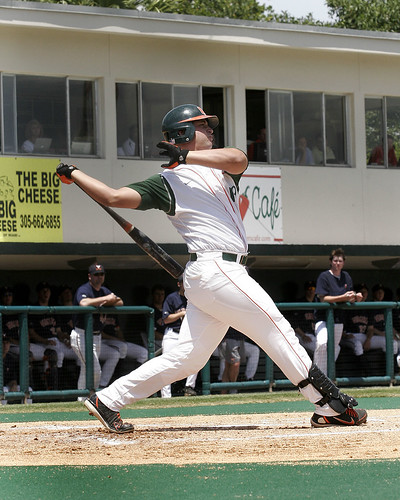
Hey everybody, even though I don't have a clue when I'm going to be able to read all of them, I bought 3 baseball related books today. Johnny Damon's Idiot, The Long Ball, and We Are The Ship: The Story of the Negro League now all enjoy their very own spot on my bookshelf. I think I'll work my way through each of them as Spring Training approaches.
Speaking of Spring Training, who else is excited to check in on Yonder Alonso, the Reds' first round pick in '08?
Over the last month I've spent some time digging through old college stats of players that have been both studs and duds in the majors. Project Prospect recently ran a very nice article by Lincoln Hamilton, who has concocted his own evaluation system for college hitters, and I tend to agree with the majority of his assessments. Power, strike out rates, and walk rates seem to play the largest factors in the success of a collegiate slugger once they reach the pro level (if you consider OPS a measure of success).
Without delving too much into the mathematics of it all, I just want to take a moment to point out Yonder Alonso's stats at the University of Miami.

Alonso managed a BB% of 21%, while striking out just 12.6%. Also, 42% of his hits were for extra bases. By comparison, Pedro Alvarez who the Pirates selected with the #3 pick finished his college career with 42% of his hits going for extra bases (just like Alonso), but had a 15.5% walk rate and a strike out rate of 19.5% (I realize Alvarez had some injury issues, but the difference is too significant to ignore). In essence, for every 100 plate appearances, both players had similar power production when putting the ball in play, but Alvarez had 6 fewer walks with 7 more strikeouts than Alonso. That's a total of 13% of all plate appearances that Alvarez was unable to produce, while Alonso maintained offensive leverage simply by having better plate discipline.
It might seem like a small difference, but if the future success of most college hitters can be best evaluated based off of power, strike out rates, and walk rates, then I'd have to say that going into the '09 season, I like Alonso's chances of early success more than those of Alvarez.
If we look beyond Alvarez, Alonso's collegiate offensive stats compare very well to those of Alex Gordon, Ryan Braun, and Matt Weiters. As if those comparables weren't enough to sell me on Alonso, we also have to remember that Great American Ballpark is one of the friendliest parks in the nation for left handed power hitters.
Of course, the future is not set in stone, and Alonso still has to work his way past Joey Votto, but I think there's a very good chance that 3 or 4 years from now, Alonso will be a well established star, and the Reds will use Votto to trade for some pitching or a couple of solid prospects.
TPC Comparable Player: Carlos Quentin
TPC Preliminary Projection: .280-.300 average, 30-40 homeruns
Saturday, January 10, 2009
Tommy Hanson Pitching Mechanics
As most of you know, I think that Tommy Hanson has been a bit over hyped, and he'll struggle for a few years in the majors before putting it all together. DriveLineMechanics.com has an interesting breakdown of his mechanics. Good arm action, but his finish leaves his release point high in my opinion, which helps explain his low GB% (the dominant and glaring weakness in his game).
Subscribe to:
Posts (Atom)

