


Showing posts with label Madison Bumgarner. Show all posts
Showing posts with label Madison Bumgarner. Show all posts
Sunday, April 5, 2009
Project Prospect Madison Bumgarner Scouting Report
For those of you interested, Project Prospect recently posted a scouting report covering Madison Bumgarner's most recent Spring Training start against the Dodgers. The report includes uninterrupted video of each of the 3 innings Bumgarner pitched, including a 3 pitch strikeout against Manny Ramirez. It's an excellent report, and well worth checking out. Great job once again guys!


Thursday, March 26, 2009
TPC 2009 Top 10 Power Pitchers

Everybody loves a good strikeout performance, and these guys can do it with the best of them. Whether it's a 3 digit fastball or a ridiculous curve, batters just don't seem to be able to keep up.
Before we get started, I want to clarify that this list is not meant to reflect the minor league players with the most strikeouts in 2008, or the pitchers that I think will have the most strikeouts in 2009. This list is a ranking of the players that I feel have displayed a capacity to become average to great major league strikeout pitchers. The factors considered included stats, scouting reports, age, competition level, and comparable players.
(*As with my power and contact hitters list, this list excludes all players that either have not played in the minors, or have sample sizes that are too small for analytical comparisons. If you would like, you can consider Stephen Strasburg the #1b pick considering his recent performances and elite scouting reports.)
Ok, now for the good stuff.
1. Neftali Feliz -- Big time stuff, with decent control to boot. At just 20 years old, Feliz can top out at a cool 100 mph with his fastball, and he struck out 33% of the batters he faced at A ball in 2008.
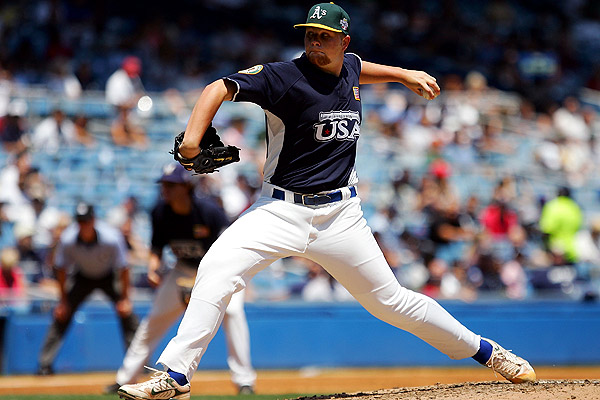
2. Madison Bumgarner -- For a while, Bumgarner was a pure fastball pitcher, but has since developed some decent secondary offerings. At just 18 years old, his fastball had been clocked at 95 mph, and with a 6'4", 215 lbs frame there's reason to believe he could add a bit more velocity in the coming years. Finished out A ball by striking out 42% of the batters he faced over his last 32 innings.
3. Tommy Hanson -- Though his fastball was in the low 90's as recently as last April, Hanson has been in the high 90's range for the past several months, and has been throwing a nasty slider as well. Past stats aren't great, but perhaps the best is yet to come.
4. Christian Friedrich -- Friedrich had a great professional debut in '08, striking out over 12 batters per 9 innings pitched. His fastball usually stays around the 89-92 range, but he also throws a very good curve ball that misses a lot of bats. At just 20 years old,
5. Dellin Betances -- At 6'9", Betances can be a very intimidating guy. Toss in a 98 mph fastball (although it usually doesn't break 95 in games), and a promising knuckle curve, and it looks like the Yankees might need to make room for Betances in another couple of years.
6. Gio Gonzalez -- Although his stint in the majors didn't go so well (7.68 ERA, 1.68 WHIP in 34 innings), Gonazalez still struck out a batter an inning. He's got the stuff to be a major league pitcher, and at just 23 years old he still has plenty of time to develop.
7. Jeremy Jeffress -- Depending on the radar gun, Jeffress has been clocked as high as 102 mph, and while control remains an issue (both on and off the mound), he's got tons of talent and youth on his side. At 20 years old, Jeffress struck out 30% of the batters he faced at A+ ball, and has a career K/9 or 10.4.
8. Chris Tillman -- While control remains an issue for Tillman, he put in some very nice performances at AA last year as a 20 year old, averaging 10.2 strikeout per 9 innings. Tillman tops out around 94 mph, and mixes in a curveball and change-up to keep batters guessing.
9. Trevor Cahill -- Cahill shares several qualities with Tillman, managing to dominant at times, and lose control at others. He usually works in the low 90's, mixing in several other pitches, including a knuckle curve at times, as well as a change up and slider.
10. Will Inman -- Inman had great stats at A ball in 2006 and 2007, but doesn't quite yet have the pure stuff to blow hitters away on a regular basis at higher levels. Average fastball, decent curve, lots of time to work on both, and a future career in the pitcher friendly confines of San Diego.
Almost made the list:
Jake McGee (Tommy John victim) -- likely would have made the top 5
Cole Rohrbough (ankle surgery) -- should be good to go in '09
Nick Barnese -- good stuff, but needs to perform above short season A ball
Michael Bowden -- control has steadily improved, but strikeouts have steadily dropped
Brett Anderson -- AA stats were impressive, but previous stats suggest an emphasis on control rather than strikeouts
Henry Rodriguez -- has struggled with consistency
Brad Holt -- also needs to prove himself against advanced hitters
Jeremy Hellickson -- great stuff, just missed the list
Brett Cecil -- great overall pitcher, not dominant strikeout guy (yet)
...Read more
Saturday, March 14, 2009
TPC 2009 Top Pitching Prospects Leftovers: David Price

So, I put David Price in at #5 instead of #1 like just about everyone else in the world is doing. I must be an idiot or something, right?
Maybe I am.
As much as I've written about Tommy Hanson, I've probably written more about David Price. I don't dislike Price, nor do I think he's a bad pitcher. In fact, I think he is very talented, and deserves most of the accolades that people have been pouring on him for the last 2 or 3 years. He was a great college pitcher, and so far has been a very solid minor league pitcher. In fact, after considering all the facts, I think Price could one day be a great major league pitcher, and might snag a Cy Young or 2 along the way.
But I don't think the problem here is whether Price is a very good pitcher or not. Most people are already convinced that he is. I think the real problem here is whether Price is or will be a great pitcher or not. At the surface, it seems like an issue of semantics. What I think of as very good, others may consider great, and vice versa. But when it comes to stats, performance level, and overall production, I think there is a definite difference between very good and great. For instance, becoming a millionaire would be a very good thing, but becoming a billionaire would be great.
So, before we move on, let me make it clear that I think Price could become a great pitcher in 3 to 5 years. I'd even put the odds at 2 to 1.
And that brings us back to the point of this post. If Price has such great potential, why the #5 ranking? Why put him behind Brett Anderson, Trevor Cahill, Brett Cecil, and Madison Bumgarner? The answer, simply put is because I have reason to believe that all 4 of them are either currently better than Price, and/or have better odds of becoming a great major league pitcher.
As for Cahill and Anderson, I've covered the subject before. But to quickly review, here's a table comparing Price's AA stats (his largest professional sample size) to Cahill, Cecil, and Anderson, as well as a few other recent pitchers.

All of those pitchers have had a lot of success in their short careers, but of the the ones that have pitched at the major league level, the difference between the pitchers at the top of the list and Price is fairly significant. As I said before, Price has been very good so far, but if Tim Lincecum and Joba Chamberlain are true elite pitchers, at this point in time, we can't really make a solid argument for putting Price on the same level with them. There's plenty of reasons to put him in with very good pitchers like Zach Greinke (and yes, Greinke is a very good pitcher, even if he does pitch for Kansas City), but anything beyond that isn't really warranted.
However, Anderson has already put in elite level performances, and at 20 years old already compares well to the guys at the top of the list. Cecil has also done very well, and Cahill has essentially matched Price's performance level even though he's 2 years younger. If Cahill begins 2009 at AA ball, I think he could put up an average of 11 strikeouts per 9 innings with 3.5 walks, and a ground ball rate between 60% and 65%, putting him in the upper half of the list above.
To take this one step further, here are the major league stats for some of the above pitchers as they compare to what Price is expected to do in 2009 (I threw in Tommy Hanson's projection as well just for fun).

I felt pretty confident putting Price behind Cahill, Anderson, and Cecil, but I felt like the biggest stretch was putting Madison Bumgarner ahead of him as well. While Bumgarner has a very high ceiling, his experience level and pitching repertoire is far inferior to Price's. He was fantastic at A ball last year, and had one of the best seasons for any 18 year old in recent memory, but he still has a long way to go, especially when you consider the fact that he pretty much only has a fastball right now with a breaking ball and change-up under development.
However, when I started taking an in-depth look at Bumgarner, something that his A ball manager Andy Skeels said about him made me realize something about the kind of growth curve Bumgarner is on. "I've never seen a player grow that fast and quickly. What he did was staggering." It's a minute detail, but it speaks volumes about how quickly Bumgarner could become an extremely dominant pitcher.
Consider this. Prior to August 2008, Bumgarner used 2 pitches during games. A fastball and a slider. With just those 2 pitches he was very good, striking out about 26% of the batters he faced, while walking just 4%. In August, he began throwing a change-up, and his strikeout rate shot up to 41%. Obviously, his change-up made a huge difference, but it gets better. You would expect a young pitcher to increase his walk rate while trying out a new pitch, but Bumgarner's August walk rate actually dropped to 2.6%. For the month, his ERA was an amazing 0.28.
If Bumgarner never develops another plus plus pitch, and he has to rely on his fastball and an average breaking ball with an average change-up (the worst case scenario), his control and raw talent would put him on roughly the same development curve as someone like David Price, and by the age of 22, Bumgarner would be able to match Price's performance level. His future would be limited, but he would still be a serviceable big league starter.
But, if Bumgarner develops a couple of plus pitches to compliment his fastball, given his current skill set, I think he could easily surpass Price in terms of pure talent. Mix in another 3 or 4 years of experience, and Bumgarner has all the makings of an elite young pitcher.
So, when it came to ranking Bumgarner, I could have gone the extremely conservative route, but after seeing how quickly he mixed in a change-up and how well he handled A ball at the age of 18, I had to put him ahead of Price. It was a decision based off of 50% projection, and 50% performance. I'm usually not very comfortable relying so heavily on the future (and unforeseeable) development of a pitcher, but there are too many indications that Bumgarner is actually on a very impressive development curve.
In short, I put David Price in at #5 on my list because I thought there were 4 other pitchers with more promising futures out there. It doesn't mean I think Price is a bum or a hack. He'll be good. Very good. But when it's all put in perspective, I think Anderson, Cahill, Cecil, and Bumgarner are going to be just a bit (or a lot) better.
However, Anderson has already put in elite level performances, and at 20 years old already compares well to the guys at the top of the list. Cecil has also done very well, and Cahill has essentially matched Price's performance level even though he's 2 years younger. If Cahill begins 2009 at AA ball, I think he could put up an average of 11 strikeouts per 9 innings with 3.5 walks, and a ground ball rate between 60% and 65%, putting him in the upper half of the list above.
To take this one step further, here are the major league stats for some of the above pitchers as they compare to what Price is expected to do in 2009 (I threw in Tommy Hanson's projection as well just for fun).

Good. Very good in fact. But not great.
I guess what I'm saying is, if Tim Lincecum, Joba Chamberlain, Francisco Liriano, and Zach Greinke were all about to make their major league debuts this year, how high would you rank Greinke compared to the other 3? I don't think it would take more than 30 seconds of consideration before he got the #4 slot.
That's how I see the situation between Cahill, Anderson, Price, and Cecil right now. They've all received top notch reviews from baseball insiders, they've all done very well in the minors, and they all have tons of potential. The only thing separating them is the numbers they've put up, and the age at which they did so.
To add a bit more perspective, here's a recent quote from Rays manager Joe Maddon concerning Price and the reason he'll likely start the season at AAA coming out of Spring Training:
"If he just blows people away, things obviously can change," Maddon said. "We can change our thinking. … (But) we still consider him in the development process. … If you were watching the playoffs last year, you see him as the finished product, but we don't necessarily see it there yet."
Sure, the Rays have a lot of pitching depth, but so do the Yankees, and there's really no question as to whether 23 year old Joba Chamberlain is going to get a spot in the rotation. If Price was an true elite pitching prospect, at 23 he'd be more than ready to take a spot in the Rays rotation, and Maddon wouldn't be saying things like, "...we don't necessarily see it there yet."I felt pretty confident putting Price behind Cahill, Anderson, and Cecil, but I felt like the biggest stretch was putting Madison Bumgarner ahead of him as well. While Bumgarner has a very high ceiling, his experience level and pitching repertoire is far inferior to Price's. He was fantastic at A ball last year, and had one of the best seasons for any 18 year old in recent memory, but he still has a long way to go, especially when you consider the fact that he pretty much only has a fastball right now with a breaking ball and change-up under development.
However, when I started taking an in-depth look at Bumgarner, something that his A ball manager Andy Skeels said about him made me realize something about the kind of growth curve Bumgarner is on. "I've never seen a player grow that fast and quickly. What he did was staggering." It's a minute detail, but it speaks volumes about how quickly Bumgarner could become an extremely dominant pitcher.
Consider this. Prior to August 2008, Bumgarner used 2 pitches during games. A fastball and a slider. With just those 2 pitches he was very good, striking out about 26% of the batters he faced, while walking just 4%. In August, he began throwing a change-up, and his strikeout rate shot up to 41%. Obviously, his change-up made a huge difference, but it gets better. You would expect a young pitcher to increase his walk rate while trying out a new pitch, but Bumgarner's August walk rate actually dropped to 2.6%. For the month, his ERA was an amazing 0.28.
If Bumgarner never develops another plus plus pitch, and he has to rely on his fastball and an average breaking ball with an average change-up (the worst case scenario), his control and raw talent would put him on roughly the same development curve as someone like David Price, and by the age of 22, Bumgarner would be able to match Price's performance level. His future would be limited, but he would still be a serviceable big league starter.
But, if Bumgarner develops a couple of plus pitches to compliment his fastball, given his current skill set, I think he could easily surpass Price in terms of pure talent. Mix in another 3 or 4 years of experience, and Bumgarner has all the makings of an elite young pitcher.
So, when it came to ranking Bumgarner, I could have gone the extremely conservative route, but after seeing how quickly he mixed in a change-up and how well he handled A ball at the age of 18, I had to put him ahead of Price. It was a decision based off of 50% projection, and 50% performance. I'm usually not very comfortable relying so heavily on the future (and unforeseeable) development of a pitcher, but there are too many indications that Bumgarner is actually on a very impressive development curve.
In short, I put David Price in at #5 on my list because I thought there were 4 other pitchers with more promising futures out there. It doesn't mean I think Price is a bum or a hack. He'll be good. Very good. But when it's all put in perspective, I think Anderson, Cahill, Cecil, and Bumgarner are going to be just a bit (or a lot) better.
Friday, March 13, 2009
TPC 2009 Top Pitching Prospects: 1-5
It's here! The final installation in the TPC 2009 top pitching prospects countdown is finally finished. We've covered 6 through 10, 11 through 15, and 16 through 20, but I saved the best (and probably the most surprising) for last. It's similar to other lists I've seen, but also very different in a few ways. I'm going to write a follow-up post soon to discuss some of the players that missed the cut, as well as why certain players got ranked a certain way. Let me know what you think, and feel free to ask questions. While at present this list may seem radical to some, I think in time it will prove to be very accurate.
 Like I said, I'll have a follow up post coming out soon to address some of the players left off the list, as well as some charts and comparisons to justify my rankings.
 Monday, March 9, 2009
Update and Contest Time: TPC 2009 Top 10 Hitting Prospects

After much thought and deliberation, I've decided that the TPC 2009 Top 10 Hitting Prospects list would not be complete if I left Michael Stanton off the list. At first, I felt like his strikeout rate was a deal breaker, but the more I looked at his 2008 stats and searched for comparable players, the more I realized that the Marlins are holding on to a very special player. Sure, he struck out a lot, but he was only 18, and I think if he were to stay at A ball for another 2 years, he'd be a 20 year old with a K% of 20% or less hitting 40 plus home runs a year (maybe 50) with an ISOP above .350.
I spent about an hour last night searching for any player in the past 20 years that has posted the types of power numbers at A ball that Stanton put up last year, and I haven't found a single one. In fact, the only player I've found that came close to comparing to Stanton's A level ISOP (.318) was Evan Longoria, who posted an ISOP of .333 between A- and A+ ball as a 20 year old. The next closest hitter was Jay Bruce, who posted an ISOP of .319 in 66 at-bats at AA at the age of 20 (Darryl Strawberry also posted an ISOP of .319 at 20 years old in AA ball, and Jose "Roids" Canseco put up a whopping .431 at the same age and level), followed by a .291 ISOP posted by Ken Griffey Jr. at the age of 18 in A ball. There are a few others that posted similar ISOPs, but they were all much older, so there really isn't much of a comparison. I'll admit up front that my search wasn't an exhaustive one, but I searched through several hundred players, including any prominent power hitter I could think of. So, to make sure I'm not mistaken about this one, I'm going to have a contest and everyone is free to enter.

If anyone can find any player that has posted an ISOP above .318 at the age of 18 years old at A ball in the past 25 years, I'll send you a 2007 Bowman Sterling Madison Bumgarner autographed card (at least 150 plate appearances is required)! Just post the player (if there is one) in the comments section, and if you're right, you win!
Anyways, now that I feel like Stanton is worthy of a top 10 position, I'm going to slide him in with Chris Carter at #6(b). If he's able to repeat his 2008 performance at AA ball this summer and keep his K% under 30%, I think he'll be a good candidate for a top 3 ranking next year.
Thursday, February 19, 2009
One More Sleeper for 2009 Yankees Style

I was reading over the list of the top 30 pitching prospects that Project Prospect recently released, and while I thought it was a pretty solid list, I thought they left out one very important prospect that has also failed to appear on almost every other prospect list that I've seen so far.
While a lot of young pitchers drafted in the 2007 draft have received most of the fanfare, in 2008 Jairo Heredia -- a very talented but unheralded international signee in the Yankees farm system -- made a very strong case for himself to be included in the discussion of elite young arms in baseball. Below is a list of several young pitchers that appeared on the top 30 list at Project Prospect, the ranking they received, their 2008 stats, and finally the 2008 stats for the Yankees new young stud.

Of the pitchers included in the above list, I think Bumgarner is the only one that Heredia can't currently compete with. Otherwise, he posted very competitive numbers all around at A ball, and did so at a year or 2 younger than all of the other pitchers on this list. While I can't really say that he's absolutely better than any of them, I do feel like he obviously has equivalent talent and he deserves to be mentioned along side the other pitchers. Leaving Heredia off of just about every major top 100 prospects list seems like a mistake to me, and I think we'll see him rise quickly up the ranks over the next year.
...Read more
Monday, January 5, 2009
Notes on Madison Bumgarner

I just wanted to pass on what I came across while reading up on some of the post-2008 minor league awards.
Going into 2008, Mad-Bum didn't have much of a breaking ball, and relied heavily on his fastball to get batters out. However, according to an interview with mlb.com posted on November 25th, Bumgarner said:
"My slider and curve got a lot better. I didn't really have a breaking ball coming into the instructional league last year. It just got better and better [as the year went on]. It just kind of clicked."
I haven't been able to find any recent scouting reports that indicate whether Bumgardner's breaking ball pitches have improved as much as he thinks they have, but his 71 strike outs over his last 53 innings while allowing just 5 walks suggest that there is some truth to his ascertations. From July to August his strikeout rate went from a respectable 23.8% to an astounding 41%.
An interview with Bumgardner's A ball pitching coach Ross Grimsley that was posted on September 2nd contains the following:
Q: Can you break down what he throws and what he’s working on?
A: He’s worked on a slider. He had a curveball in the spring but it was erratic. It seemed more like a knuckle curve to me and he wasn’t consistent with it. The slider has gotten better. He’s around the plate with it. It’s got a sharper break and more tilt.
But the biggest thing is the changeup. He’ll need that for the higher levels and he understands that. Down here, he’s just throwing the ball by guys. The closer to home plate they get, the more he reaches back and goes after them. For 19, he’s a very mature, smart kid. He knows he’s got some things he’s got to work on to make himself a more complete pitcher, not just a thrower.
Though none of the above information is definite, there are very good indications that Mad-Bum is developing very quickly and could be developing his secondary pitches much more quickly than anyone expected. If that's the case, the Giants could have a very talented young major league ready pitcher on their hands within the next 2 to 3 years.
Saturday, August 30, 2008
Quick Hits from the Minors
With the Olympics over, guys like Matt LaPorta and Brett Anderson are back to work in the minors.
...Read more
- Matt LaPorta -- While the Olympics weren't a smashing international debut for LaPorta (3 for 19 with 2 home runs), he's back to clubbing AA pitching going 3 for 6 with a home run in his first 2 games since leaving China.
- Brett Anderson -- Anderson also faced some difficulties in China (4.97 ERA in 12.2 IP), but he's back with a vengeance, posting a 59% GB% while striking out 9 and walking just 1 in 6 innings Thursday night. 92.3% of the batters that Anderson faced either struck out or hit a ground ball.
- Chris Davis -- The Rangers are pretty much toast for the season, but Davis is heating back up. Since August 18th, he's 13 for 38, with 3 home runs, 5 doubles, and 7 RBI.
- Andrew Lambo -- Does Lambo have a cool nick name yet? Maybe something like "Rambo"? In 5 games at AA, Lambo is holding a .409/.435/.864/1.299 stat line, with 3 home runs.
- Madison Bumgarner -- In low A ball where defense can be sketchy at times, it's amazing that an 18 year old (he actually turned 19 on August 1st) has done so well (1.40 ERA) in his first year of professional ball. Mad Bum is lighting it up this month, with 48 strikeouts in his last 32.1 IP and an ERA of 0.28. I wonder if he's beginning to mix in a decent breaking ball, or if he's just doing it all on his fastball still. Either way, he's had an historic season. On a side note, Bumgarner's shrinking GB% suggests that he's letting his fastball drift up high in the zone. For now, those high pitches are helping his strikeout rate, but once he gets to AA ball, those pitches will often find their way into the outfield bleachers.
- Angel Villalona -- At 17 years old, he's posting a slugging percentage (16 home runs, 29 doubles) higher than Miguel Cabrera at 17, and an average in the same vicinity as the 17 year old Miggy. Watching Villalona, it's obvious that he's a great hitter, but I don't think he's a great batter. By that, I mean that Villalona has exhibited a very poor pitch selection, with a 23.6%/4.2% K%/BB%, while posting an OBP of .306 on the year. I expect Villalona to hit for more power than Cabrera, but I don't think he'll match Cabrera's OPS production.
- Michael Bowden -- The Red Sox loss is Bowden's gain. With Josh Beckett visiting Dr. James "Death" Andrews, Bowden will face the White Sox to make the first major league start of his career Saturday. I don't expect great things from him right away, but he has lots of potential and could be a very reliable starter alongside Clay Buchholz and Jon Lester in 2 or 3 years.
- David Price -- Price continues to underwhelm me, and I really doubt the Rays will consider using him as a starter this year. Thursday night Price went 5 innings with 5 strikeouts and 3 walks. His August GB% is sitting at 55%, which is good, but he has a just 17 strikeouts in 18 innings at AAA, with 9 walks. It's becoming increasingly obvious that Price's stuff isn't very deceiving to advanced hitters, and his control isn't that great. If you compare his AAA stats to those of Tim Lincecum, Joba Chamberlain, or even Brett Cecil, you can see that for his age, Price isn't doing anything out of the ordinary.
- Brett Cecil -- Speaking of Cecil, how about his start on August 23rd? No hits over 7 innings, with 5 strikeouts and 2 walks. Since moving up to AAA, Cecil has a GB% of 69% in 30.2 innings, with a total of 92% of hitters either striking out or hitting a ground ball (compared to the 75.7% posted by David Price).
...Read more
Wednesday, August 20, 2008
Quick Hits from the Minors and Around the Web
With the Olympics going on and the approach of football season, there hasn't been a lot of chatter about baseball around the internet, but there's still plenty to talk about.
From the minors...
...Read more
- The U.S. Olympic team has had some interesting moments in Beijing, especially against the Chinese national team. Between the 2 teams, there were 7 beaned batters (including a shot to Matt LaPorta's head), 2 flattened catchers, and 3 ejections.
- Speaking of the U.S. Olympic team, last week I had the chance to watch Trevor Cahill pitch against the Cuban national team. He started out a bit shaky, but once he settled down he looked pretty good. He kept most of the Cuban hitters guessing, and ended with a few strikeouts, lots of ground balls. Cahill pitched 3 scoreless innings this morning against Japan, and teammate Brett Anderson got the win against Canada last Friday. If you're interested in box scores or overall stats, you can check out the U.S. Olympic team's website for more.
- Back here in the U.S., the A.L. Rookie of the Year race came to a standstill after Evan Longoria suffered a fractured wrist earlier this month. He should be back around the beginning of September, but it's difficult to say if he'll continue his pre-inury level of play.
- With Longoria on the DL, Chris Davis had a wide open opportunity to steal the spot light and make a run at the A.L. ROY. Unfortunately for him and the Rangers, Davis has seen a dramatic drop in his power prouction, with only 2 home runs and 2 doubles in August and an OPS of just .627 for the month. Overall, he's still hitting for a .275 average, with 12 home runs in 189 plate appearances, but unless he jumps back on the torrid pace he was on in July, he doesn't have a shot at the 2008 ROY.
- For any card enthusiasts out there, the release of 2008 Bowman Chrome is currently sweeping eBay. Other than a few good auto cards, there isn't much to this year's list of prospects.
From the minors...
- Matt Wieters -- After 200 plate appearances at AA, Wieters has a .352/.452/.605/1.057 line with 12 doubles, 9 home runs, 32 walks, and 23 strikeouts.
- Mike Moustakas -- Over the last 2 months, Moustakas is hitting .316, with 9 home runs and an ISOP around .250.
- Hank Conger -- When Conger started the year with a shoulder injury, I never expected that he'd be able to bounce back and put up the numbers we've seen from him this year (.297/.328/.480/.808). Not stunning numbers, but very good for a young catcher with Conger's potential.
- Madison Bumgarner -- In 21 innings, Bumgarner has a 39.7% K% rate for August, with a 2.7% BB%.
- Lars Anderson -- I wasn't a big believer in Anderson at the start of the season, but he has flat out raked at A+ and AA ball this year. After 114 plate appearances at AA, Anderson is hitting .347/.447/.611/1.058, with 5 home runs and 10 doubles. His .483 BABIP suggests that those numbers will come down a bit in the near future, but he still has the potential to be a Boston version of David Wright at first base.
- Dellin Betances -- In his last 18 innings, Betances has 28 strikeouts with a 54% GB% rate.
- Josh Vitters -- I've been looking for game logs on Vitters to see how far back his hitting streak goes, but the search has been unsuccessful. For August, Vitters has a .373/.407/.573/.980 line.
...Read more
Monday, August 4, 2008
Refractor Tracker 1st Edition
Alright folks, I stayed up a little bit late last night working on this, so let me know what you think. I have a few more players I'll be adding later today, but if there's a particular player you'd like to see, just let me know.
Update: For those of you unfamiliar with baseball cards these days, but are still interested in following prices, here's a quick reference guide for some of the terminology used in the following charts. (If you have other questions you'd liked anwered about card terminology, feel free to ask).
Refractor - all refractors (X-fractor, blue refractor, gold, etc.) are just normal cards, but printed in limited runs (usally 500 cards or less) and in different colors. Some colors are more rare than others.
Au - autographed card
BC - Bowman Chrome card brand
BS - Bowman Sterling card brand
/199 - card was numbered to only 199 copies
Donruss EEE - the most recent Donruss printed card brand


 ...Read more
Update: For those of you unfamiliar with baseball cards these days, but are still interested in following prices, here's a quick reference guide for some of the terminology used in the following charts. (If you have other questions you'd liked anwered about card terminology, feel free to ask).
Refractor - all refractors (X-fractor, blue refractor, gold, etc.) are just normal cards, but printed in limited runs (usally 500 cards or less) and in different colors. Some colors are more rare than others.
Au - autographed card
BC - Bowman Chrome card brand
BS - Bowman Sterling card brand
/199 - card was numbered to only 199 copies
Donruss EEE - the most recent Donruss printed card brand


 ...Read more
Thursday, July 24, 2008
Madison Bumgarner Analysis & Comparisons
Right now it must be great to be a baseball fan in northern California. Well, at least for fans that pay attention to minor league players. The Oakland A's and the San Francisco Giants both have a nice group of young pitchers in the majors and the minors, with at least 5 years before each pitcher hits their prime years. There must be something in the water, because both teams know very well how to draft young pitching talent.
And that leads us to Madison Bumgarner. Before we get into statistical comparisons and analysis, let's cover some basics first.
Madison Bumgarner throws a fastball in the low to mid 90's, with reports of hitting 96 mph. During his years in high school, Bumgarner's dad limited the development of any breaking pitches to maintain low stress levels on his arm, so his curve ball and slider are still very much under development. He has a solid change up, but mostly relies on his fastball to get batters out. His progression through the minors will probably depend on how quickly his curve and/or slider catches up with his fastball.
Bumgarner shows a sincere intent to work hard and improve. Mike Fox, head coach of the University of North Carolina at Chapel Hill had this to say about Bumgarner after learning of his original commitment to play at UNC: "Madison is a great kid with a great future. He is blessed with a great left arm, but I am more impressed with the type of young man he is. He is very humble and grounded. He obviously gets a great deal of attention but he handles himself with a great deal of maturity." Praise like that means quite a bit when it's coming from a man who has spent the majority of his life working with highly regarded prospects.
Now that we've gotten past the formalities, let's get down to business. Here are Bumgarner's 2008 stats, along with a few comparable pitchers that displayed similar performances at A ball.
 In one word, Bumgarner has been superb. He's among some very good company, and there's no doubt about his talent. However, I've read a lot of talk on the web from fans that are concerned that Bumgarner doesn't have a good secondary pitch yet. To that I say don't worry about it. While Rick Ankiel was able to dominate early because he had an incredible curve ball, and Francisco Liriano had his slider to help him through the minors, Bumgarner has relied solely on his fastball and has been able to match up well against both of those pitchers. It's an amazing feat that points to the sheer level of talent Bumgarner posesses. If Bumgarner can post a K/9 near 10 with excellent control using just his fastball, imagine what he'll be able to do when he has a decent curve, or slider, and a change up. Also keep in mind that of all pitches, the fast ball is easier to control and applies the least amount of stress to the arm, consequently reducing the overall risk of injury. Which would you rather have, a pitcher with a nasty curve, or a pitcher with an equally nasty fast ball?
So if Bumgarner compares well to guys like Ankiel and Liriano, what can we expect from him in the future? Each of the 3 pitchers in the comparison chart went on to maintain their A ball stats through AAA, and made their first MLB appearance by the age of 21. Ankiel posted an ERA of 3.50 at the age of 20, Liriano had an ERA of 2.16 at 22, and Sabathia had an ERA of 3.60 at 22. If we apply the same trends to Bumgarner, we can expect him to debut with the Giants by 2011, and post an ERA in the 3.00-3.50 range by 2012.
Obviously, Bumgarner has a ton of potential and his left arm should carry him a long way. If he develops a good secondary pitch soon, his stats should quickly reflect it and we could see him cement his place among some great pitchers. I'm a little concerned that his July K% has seen a slight drop, but I think it's most likely due to late season fatigue since this is Bumgarner's first full year of professional ball. I expect the Giants -- who have demonstrated an above average to develop young pitchers -- to shut him down pretty soon, and let him rest through the end of the winter before putting him back to work.
...Read more
And that leads us to Madison Bumgarner. Before we get into statistical comparisons and analysis, let's cover some basics first.
Madison Bumgarner throws a fastball in the low to mid 90's, with reports of hitting 96 mph. During his years in high school, Bumgarner's dad limited the development of any breaking pitches to maintain low stress levels on his arm, so his curve ball and slider are still very much under development. He has a solid change up, but mostly relies on his fastball to get batters out. His progression through the minors will probably depend on how quickly his curve and/or slider catches up with his fastball.
Bumgarner shows a sincere intent to work hard and improve. Mike Fox, head coach of the University of North Carolina at Chapel Hill had this to say about Bumgarner after learning of his original commitment to play at UNC: "Madison is a great kid with a great future. He is blessed with a great left arm, but I am more impressed with the type of young man he is. He is very humble and grounded. He obviously gets a great deal of attention but he handles himself with a great deal of maturity." Praise like that means quite a bit when it's coming from a man who has spent the majority of his life working with highly regarded prospects.
Now that we've gotten past the formalities, let's get down to business. Here are Bumgarner's 2008 stats, along with a few comparable pitchers that displayed similar performances at A ball.
 In one word, Bumgarner has been superb. He's among some very good company, and there's no doubt about his talent. However, I've read a lot of talk on the web from fans that are concerned that Bumgarner doesn't have a good secondary pitch yet. To that I say don't worry about it. While Rick Ankiel was able to dominate early because he had an incredible curve ball, and Francisco Liriano had his slider to help him through the minors, Bumgarner has relied solely on his fastball and has been able to match up well against both of those pitchers. It's an amazing feat that points to the sheer level of talent Bumgarner posesses. If Bumgarner can post a K/9 near 10 with excellent control using just his fastball, imagine what he'll be able to do when he has a decent curve, or slider, and a change up. Also keep in mind that of all pitches, the fast ball is easier to control and applies the least amount of stress to the arm, consequently reducing the overall risk of injury. Which would you rather have, a pitcher with a nasty curve, or a pitcher with an equally nasty fast ball?
 So if Bumgarner compares well to guys like Ankiel and Liriano, what can we expect from him in the future? Each of the 3 pitchers in the comparison chart went on to maintain their A ball stats through AAA, and made their first MLB appearance by the age of 21. Ankiel posted an ERA of 3.50 at the age of 20, Liriano had an ERA of 2.16 at 22, and Sabathia had an ERA of 3.60 at 22. If we apply the same trends to Bumgarner, we can expect him to debut with the Giants by 2011, and post an ERA in the 3.00-3.50 range by 2012.
Obviously, Bumgarner has a ton of potential and his left arm should carry him a long way. If he develops a good secondary pitch soon, his stats should quickly reflect it and we could see him cement his place among some great pitchers. I'm a little concerned that his July K% has seen a slight drop, but I think it's most likely due to late season fatigue since this is Bumgarner's first full year of professional ball. I expect the Giants -- who have demonstrated an above average to develop young pitchers -- to shut him down pretty soon, and let him rest through the end of the winter before putting him back to work.
...Read more
Thursday, July 17, 2008
Quick Hits from the Minors
Sorry for the lack of posting yesterday, folks. I've got a couple exams coming up as well as a pile of lab work to finish by this afternoon. Anyways, I wanted to note some nice performances from yesterday and add some of my own comments.
-Adam G.
...Read more
- Hank Conger -- 3 for 4, 3 home runs -- In 125 plate appearances, Conger is hitting .295 with 5 home runs and 9 doubles. He seems to be doing very well after rehabbing his injured throwing shoulder, and I think he could be a very good major league catcher in a few years with the Angels.
- Madison Bumgarner -- 7 IP, 11 K, 0 BB -- We've seen a slight drop in Bumgarner's GB% rate lately, but he continues to post very good numbers, even when he has low strike out totals. He has a 1.79 ERA in 95 innings...and he's still only 18 years old.
- Josh Vitters -- 3 for 5, 1 2B -- Vitters continues to hit like a maniac, and he's now sitting on a .327 average in Boise, and he's also only 18 years old.
- Freddie Freeman -- 2 for 3, 1 home run -- Freeman is putting up some very nice numbers, including an OPS of .923. Like Vitters and Bumgarner, Freddie is only 18 years old, and is quickly establishing himself as one of the best hitters in A ball. His splits still bother me, but I can overlook them for now.
-Adam G.
...Read more
Subscribe to:
Posts (Atom)


